
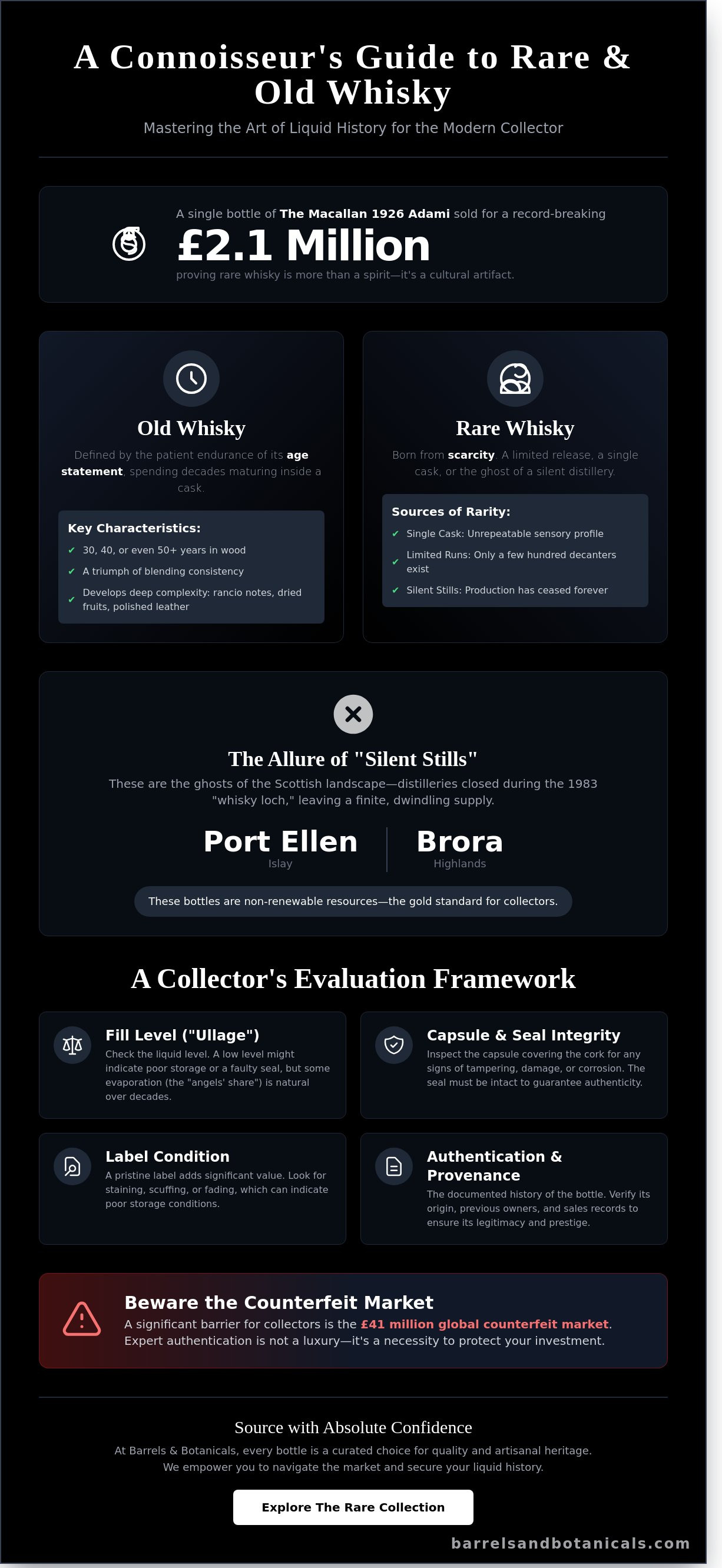
Can a single centilitre of liquid truly capture the essence of 1940s Speyside? In November 2023, a bottle of Macallan 1926 Adami sold for a record-breaking £2.1 million at Sotheby’s in London, proving that rare and old whisky is far more than a spirit; it's a profound cultural artifact. You likely recognize that the true value of these bottles lies in the ritual of the pour and the storied heritage of silent distilleries like Port Ellen or Brora. It's an appreciation for the nuanced, vibrant history trapped behind glass. A celebration of time itself.
We understand the weight of your ambition to secure a "unicorn" bottle, yet the reality of a £41 million global counterfeit market remains a significant barrier for many UK collectors. Our guide empowers you to source with absolute confidence, distinguishing between investment-grade assets and the exquisite expressions meant for a celebratory glass. You'll discover how to verify provenance with surgical precision and secure professional valuations that reflect the current 2026 market climate. From the first nose to the final, lingering finish, we're here to help you master the art of liquid history and elevate your collection to a professional standard.
Key Takeaways
- Distinguish between chronological age and true scarcity to appreciate the nuanced, vibrant palate of a spirit evolved by time.
- Uncover the allure of "Silent Stills," exploring why legendary names like Port Ellen and Brora remain the gold standard for UK collectors.
- Master the framework for evaluating rare and old whisky, assessing everything from fill levels to capsule integrity for investment or enjoyment.
- Secure your liquid history with expert techniques for authentication and provenance, ensuring your collection's prestige and future resale value.
- Discover the Barrels & Botanicals Ltd philosophy for sourcing, where every bottle is a curated choice for quality and artisanal heritage.
Defining the Extraordinary: What Makes a Whisky Rare and Old?
To hold a glass of rare and old whisky is to possess a fragment of history. It's a sensory experience that transcends the simple act of drinking. While many conflate the terms, "old" and "rare" represent two distinct paths to excellence. An old whisky is defined by the patient endurance of its age statement, often spending 30, 40, or even 50 years inside a cask. Rarity, however, is born from scarcity. It's the ghost of a silent distillery that ceased production in 1983, or a limited release where only a few hundred decanters exist worldwide.
The spirit undergoes a profound sensory evolution during these decades. The harsh edges of new-make spirit soften into a nuanced, vibrant palate. While the "angels' share" represents the physical volume lost to evaporation, we celebrate the gain. This is the gain of complexity. The gain of deep, rancio notes, dried fruits, and polished leather. This Whisky overview details how different grains and regions contribute to this foundation, but time in the wood is what creates the final masterpiece.
The year 2026 stands as a pinnacle for the industry. It represents a unique window where legendary casks filled during the production booms of the 1970s and 1980s are reaching their absolute peak of maturation. This availability has sparked a global resurgence in vintage interest, making the current market a golden era for those seeking the essence of the dram.
The Age Statement vs. The Vintage Year
Understanding the label is the first step in appreciation. A 40-year-old expression is a triumph of consistency, often blending several casks to achieve a signature house style. In contrast, a 1970s vintage bottling is a time capsule. It captures the specific climatic conditions and water chemistry of a single year. These bottles represent liquid history, offering a profile that can't be replicated by modern techniques. Vintage is the intersection of a specific harvest and a master blender’s intuition. For those building a collection, the choice between age and year defines the character of their vintage whisky journey.
The Rarity Factor: Limited Runs and Single Casks
True rarity often resides in the single cask. These releases offer an unrepeatable sensory profile because no two oaks breathe the same way. In the UK, the allure of the "unicorn" bottle has transformed rare and old whisky into a cultural phenomenon. These aren't mass-market products. They're the cornerstone of the artisanal movement. Small-batch production ensures that the quality remains uncompromising, focusing on the ritual of the pour rather than the volume of the sale. When a cask is emptied, that specific flavor profile vanishes from the world, leaving only the memory of the taste.
The Pantheon of Rarity: Lost Distilleries and Legendary Vintages
To hold a bottle from a silent still is to touch a fragment of liquid history. These are the ghosts of the Scottish landscape; distilleries that ceased production during industry shifts, leaving behind a finite and dwindling supply of spirit. Names like Port Ellen on Islay and Brora in the Highlands represent the gold standard for collectors. They offer a sensory profile that modern production often struggles to replicate. This isn't a story of loss. It's a celebration of exceptional character that survives only in the glass. Each pour is a deliberate act of preservation.
Whisky from the Silent Stills
The 1983 "whisky loch" remains a pivotal moment in distilling history. An oversupply of spirit led to the permanent closure of dozens of iconic sites. Today, this historical cull defines the scarcity of rare and old whisky. These bottles are non-renewable resources. Once the final cask is bottled, that distillery’s voice is silenced forever. This absolute limit on supply has a profound impact on the market value of rare whiskey, where provenance and rarity dictate prestige. Identifying the perfect bottle of rare and old whisky requires an understanding of these "golden eras" of Scotch production, particularly from the 1960s to the late 1970s.
- Sensory Profiles: Lost malts often feature heavy, waxy textures or delicate, soot-inflected coastal peating. Vibrant botanicals of the past.
- The 1983 Impact: Sites like St. Magdalene and Rosebank were closed not for quality issues, but for logistical ones, leaving behind world-class liquid.
- Market Prestige: Academic analysis of Luxury Single Malt Whiskies suggests that these "ghost" stocks consistently outperform modern releases in terms of historical significance and investment potential.
Legendary Independent Bottlers
While official distillery releases carry a certain weight, independent houses like Gordon & MacPhail and Signatory Vintage are the true custodians of rarity. They’ve spent over a century sourcing the finest casks and aging them in their own warehouses. These bottlers offer a nuanced "nose" on familiar names. A Signatory bottling of a 1990s vintage might showcase a vibrant, sherry-forward profile that differs entirely from the distillery’s standard expression. It’s an artisanal approach to curation. Each bottle represents a specific ritual of selection. The essence of the craft is found in these small-batch releases. You can explore these unique expressions and find your next centerpiece when you view our curated collection in Turriff.
Evaluating the Collection: A Framework for the Modern Connoisseur
Acquiring rare and old whisky is a pursuit of both passion and precision. Every bottle tells a story of a specific season, a particular cask, and a master blender’s singular vision. When you stand before a collection in Turriff, you must decide the fate of each find. Is it an investment grade asset destined for a climate-controlled vault, or a drinking grade treasure intended for the glass? Deciding this early preserves both the liquid’s value and your own peace of mind. Implementing sound rare whisky investment strategies involves more than just buying a label; it requires an eye for the liquid's physical integrity. High fill levels, pristine capsules, and original wooden cases are the hallmarks of a bottle that has been respected through the decades.
The secondary market in 2026 demands a higher level of sophistication from buyers. Provenance has overtaken pure age statements as the primary driver of value. A 20 year old bottle with a documented journey from a closed distillery often commands more respect than a 40 year old release with a fractured history. You should look for clarity in the glass and vibrancy in the labels. These details are the quiet witnesses to how a bottle was stored. Faded ink or mid-shoulder fill levels suggest a life spent in fluctuating temperatures, which can mute the nuanced botanicals and esters within the spirit.
The Connoisseur’s Checklist for Acquisition
Verifying the sensory profile begins long before the cork is pulled. Use reputable tasting notes to cross-reference the expected "nose" and "finish" of the vintage. Consider the ritual value of the purchase. Is this bottle meant to anchor a milestone celebration, or is it a study in artisanal blending? We are seeing a profound "New World" influence on traditional Scotch rarity, where techniques from Japanese and Australian distillers push Scottish houses to innovate with unique cask finishes. This cross-pollination makes the 2026 market more vibrant and complex than ever before.
Market Trends: Rare Whisky Prices in 2026
Rare whisky continues to perform as a resilient alternative asset class, though the focus has shifted toward mindful collecting. Investors are no longer chasing every limited release; they are seeking bottles with "soul" and historical significance. Data from early 2026 indicates that artisanal expressions from smaller, independent distilleries have seen a 12 percent increase in auction demand compared to mass-market luxury brands. This is why buying rare scotch online in the UK requires a trusted retail partner who can guarantee authenticity. A reputable partner ensures that the £2,000 or £20,000 you spend secures a piece of liquid history, not just a glass ornament.
The Guardian’s Guide: Authentication, Provenance, and Preservation
A collection of rare and old whisky is a liquid library. It demands reverence. It requires a watchful eye. To own these spirits is to act as a temporary guardian of history, ensuring that the liquid inside remains as vibrant as the day it left the cask. Proper stewardship begins with absolute certainty of origin. Without a verified lineage, even the most beautiful bottle is merely a glass ornament.
Spotting the Exceptional from the Imitation
Counterfeiters have grown sophisticated, but they often stumble on the fine details. Examine the glass closely. Authentic bottles from the mid-20th century typically feature specific manufacturer markings on the base, such as those from United Glass Bottle (UGB). Feel the label paper. True vintage labels possess a specific texture and weight that modern digital printers cannot replicate. Modern technology now plays a pivotal role. High-end collectors use NFC tags and even handheld spectrometers to verify the chemical fingerprint of the spirit. If a bottle is offered at 30% below the 2024 market valuation, it's a red flag. Quality has a price. Rare spirits don't go on sale.
Documentation is the heartbeat of value. Every receipt, auction record, and certificate of authenticity belongs in a digital and physical archive. Provenance tells the story of the bottle's journey, from a cool Highland cellar to your own cabinet. This paper trail is what transforms a simple bottle into a high-value asset for future connoisseurs. It's the difference between a curious find and a blue-chip investment.
The ritual of preservation is a daily commitment. Light is the primary enemy. UV rays degrade the delicate esters that provide those nuanced, fruity notes. Keep your collection in total darkness or behind UV-filtered glass. Temperature matters too. Aim for a consistent 15°C to 18°C. Avoid the attic or the kitchen. Spirits don't like to sweat. Store bottles upright, always. The high alcohol content will erode a cork if left in contact for years, leading to leaks and tainted flavors. Once every six months, gently tilt the bottle to moisten the cork, then return it to its vertical vigil.
The Private Brokerage Advantage
When the time comes to transition your collection, the path you choose dictates the return. While traditional auctions offer a public stage, they often come with heavy fees and unpredictable outcomes. Private brokerage offers a more refined, discreet alternative. You can sell my whisky collection in Scotland and across the UK through a trusted partner who understands the liquid's true soul. This commission-based approach ensures your rare and old whisky reaches a global network of serious buyers without the sting of a 25% hammer fee.
Ready to discover the true value of your liquid assets? Consult with our experts for a professional valuation today.
Sourcing the Exceptional: The Barrels & Botanicals Rare Collection
At Barrels & Botanicals, we don't simply stock spirits; we curate a legacy. Every bottle in our Turriff shop represents a deliberate choice for quality over volume. As a family-run business, our approach is deeply personal. We treat each client with the warmth we'd offer a guest in our own home, ensuring that every interaction feels like an invitation into a shared passion. Our collection of rare and old whisky is a testament to this philosophy, focusing on the gain of complex flavors and the beauty of liquid history.
The Barrels & Botanicals difference lies in our meticulous sourcing. We look for the nuance. The vibrancy. The story. Refinement doesn't end with the dram, either. We often pair our exceptional whiskies with artisanal gins or premium cigars to create a complete sensory landscape. For those looking to manage their own prestigious cellar, we offer a private bottle sale service. We provide expert guidance on valuations and acquisitions, treating your collection with the same reverence we apply to our own inventory.
A Curated Portfolio of Liquid History
Our commitment to sourcing "lost treasures" takes us across the Highlands and Islands. We seek out the forgotten casks and the limited releases that define an era. This isn't just retail; it's a host’s welcome. Whether you engage with us through our digital platform or visit our physical space in Turriff, the experience is elevated. We invite you to explore our ever-evolving selection of rare and old whisky, where each bottle is a portal to a different time and a specific terroir.
- Hand-selected casks from mothballed distilleries.
- Direct relationships with independent bottlers across Scotland.
- A focus on provenance and authentic storytelling.
The Ritual of Consumption
A rare dram deserves more than a standard tumbler. We advocate for the ritual of mindful preparation. Use a tulip-shaped Glencairn glass to concentrate the delicate aromas of the nose. Add a single drop of water to unlock the esters on the palate. This isn't just drinking; it's an act of respect for the craft. We bridge traditional bar culture with modern wellness by encouraging you to slow down and savor the essence of the spirit.
Our philosophy centers on the idea that quality triumphs over quantity. By focusing on the sensory details, from the weight of the glass to the finish on the tongue, we transform a simple drink into a sophisticated experience. Explore our Rare & Old Whisky collection today and discover the art of intentional living through fine spirits.
Begin Your Legacy of Liquid Gold
Collecting rare and old whisky is an act of preservation, a way to capture the sensory essence of silent distilleries and the mastery of long-departed blenders. You now understand the rigorous framework for authentication and the historical weight held by legendary vintages from the 1960s and 1970s. Every bottle represents a finite moment in time, requiring meticulous provenance and a guardian's eye for detail. As a family-run business with deep Scottish heritage, Barrels & Botanicals serves as your expert guide through this complex landscape. We offer a bespoke private bottle brokerage service, specializing in rare single malts and small-batch spirits that define the pinnacle of craft. Whether you're seeking to diversify a portfolio or find a singular masterpiece, the ritual of the perfect pour begins with expert sourcing. It's your turn to steward these liquid relics for the next generation of enthusiasts. Discover our curated selection of rare and old whisky and find your next extraordinary acquisition today.
Frequently Asked Questions
What is the oldest whisky ever bottled?
The Macallan 81-Year-Old, known as The Reach, is currently the oldest whisky ever bottled. Distilled in 1940 and released in 2022, this extraordinary liquid matured in a single sherry-seasoned oak cask for over eight decades. It represents a pinnacle of patience and artisanal craft. With only 288 decanters produced, it's a vibrant piece of liquid history that captures the essence of a bygone era.
Is rare whisky a good investment in 2026?
Rare whisky remains a compelling alternative asset for 2026 based on sustained historical performance. The Knight Frank Rare Whisky Index tracked a 373% increase in value over the ten years leading into 2024. While markets fluctuate, the physical scarcity of aged stocks supports long-term growth. Investors typically focus on blue-chip distilleries to anchor their portfolios, seeking bottles with impeccable provenance and limited release numbers.
How can I tell if my old whisky bottle is still safe to drink?
Check the liquid clarity and the integrity of the seal to ensure your bottle is safe. High-proof spirits don't expire or harbor bacteria like perishable goods. If the liquid isn't cloudy and the cork hasn't crumbled into the spirit, the dram is preserved. Be cautious if you see significant sediment or a disintegrated cork. These factors can spoil the nuanced flavor profile even if the spirit remains safe.
Does the value of whisky increase once the bottle is opened?
The market value of rare and old whisky drops the moment you break the original seal. Collectors and specialist auction houses require unopened bottles to guarantee the spirit's authenticity and quality. An open bottle is a choice for personal ritual and sensory pleasure rather than financial gain. Once the seal is gone, the bottle transitions from a liquid asset to a private experience for the palate.
What is a "silent distillery" and why are their whiskies so expensive?
A silent distillery is a site that has permanently closed its doors and ceased all production. Iconic names like Port Ellen and Brora fall into this category. These whiskies are expensive because the supply is finite; every bottle opened brings the world closer to the total exhaustion of that specific stock. They offer a rare, unrepeatable glimpse into the traditional distilling techniques and unique botanical profiles of the past.
How much commission do whisky brokers typically charge?
UK whisky brokers and auction houses typically charge a seller's commission between 10% and 15% of the final hammer price. You must also account for a buyer's premium, which usually sits around 15% plus VAT. Some brokers might negotiate lower rates for premium collections valued over £50,000. It's vital to confirm all additional costs, such as professional photography or insurance, before you consign your bottles for sale.
How should I store a rare whisky bottle to prevent evaporation?
Store your bottles upright in a cool, dark space with a stable temperature between 15°C and 18°C. Keeping them away from direct sunlight prevents the spirit from expanding and escaping through the cork. Unlike wine, the high alcohol content in whisky can degrade the cork if left in constant contact. Many collectors use a secondary seal like Parafilm to wrap the capsule, ensuring the vibrant essence stays inside the bottle.
Can I sell a single bottle of rare whisky, or does it have to be a full collection?
You can certainly sell a single bottle of rare and old whisky through specialist brokers or auction platforms. High-value individual bottles often perform better than bulk lots because they attract targeted interest from specific connoisseurs. In the UK market, a single well-preserved vintage from the 1960s or 1970s can command more attention than a dozen standard releases. Quality and rarity always take precedence over the sheer volume of a collection.