
A bottle of 1978 vintage whisky isn't just a spirit. It's a liquid record of a year when the UK faced the "Winter of Discontent" and groundbreaking scientific advancements captured the world's attention. You know that a truly exceptional dram should offer a narrative, not just a proof. However, standing before a mahogany shelf of rare bottles, the difference between a 30-year age statement and a specific distillation year often feels like a riddle. It's natural to fear overpaying £400 for a label that promises history but delivers only marketing hype. Bold history. Poured neat.
We'll help you master this complexity. This guide explores the alchemy of time, showing you exactly how the climate of a single year shapes the nose, palate, and finish of a spirit. You'll gain the knowledge to select from a rare spirits list with absolute certainty. From deciphering distillation dates to the quiet ritual of savouring a 40-year-old dram, we'll show you how to experience the art of the vintage with confidence.
Key Takeaways
- Master the subtle distinction between distillation years and age statements to accurately gauge the liquid history held within every bottle.
- Uncover how the alchemy of seasoned casks and the "Angel’s Share" breathe life into vintage whisky, concentrating complex flavours over decades of maturation.
- Learn to navigate the world of independent bottlers and vintage reputations to curate a collection defined by authenticity and exceptional quality.
- Elevate your tasting experience into a mindful ritual by selecting the perfect glassware to concentrate and celebrate nuanced botanical aromas.
Defining the Essence: What Truly Constitutes a Vintage Whisky?
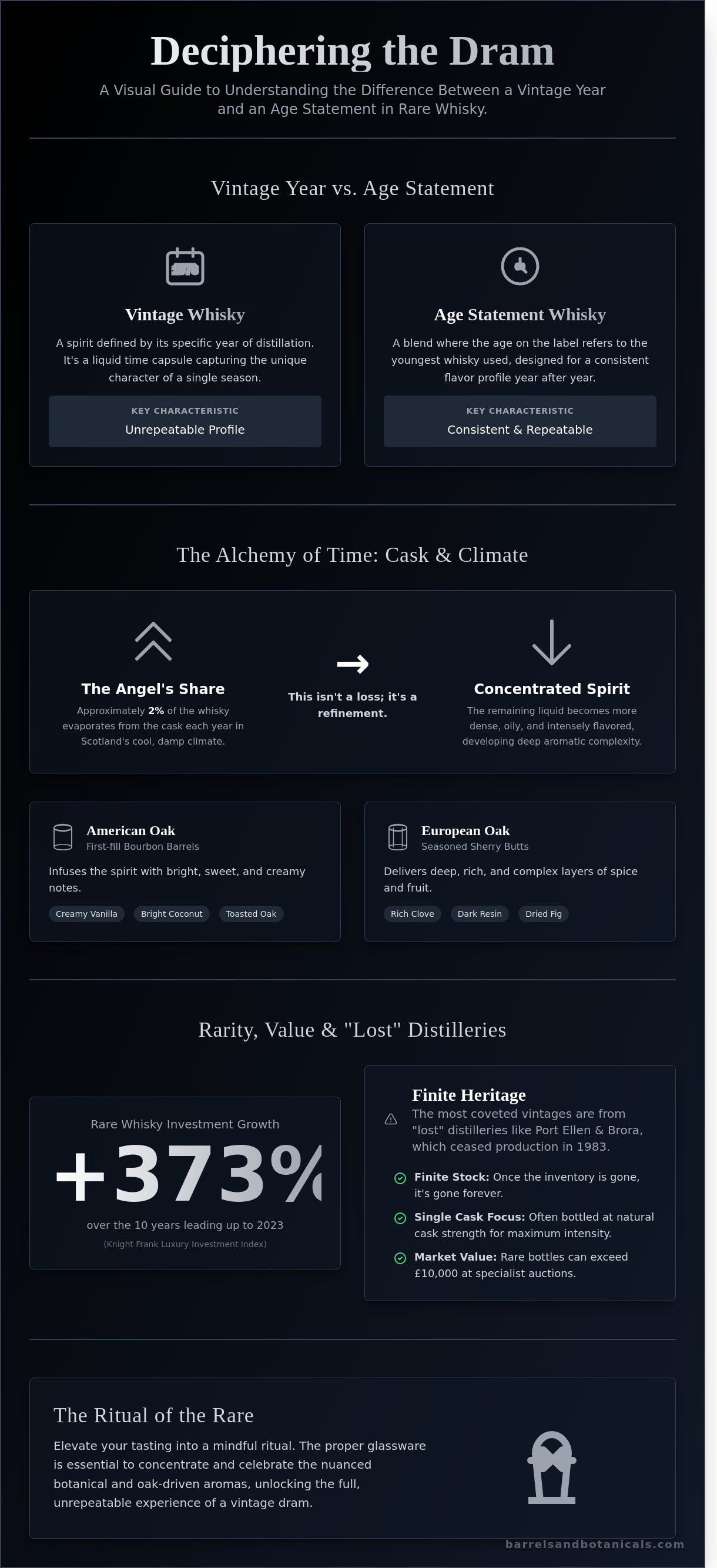
The word "vintage" carries a weight of history. It isn't just a label; it's a sensory invitation to a specific moment in time. In the world of Scotch and global spirits, a vintage whisky represents a departure from the consistent, repeatable profiles of core range expressions. While a standard 12 year old bottling aims for a uniform flavour profile year after year, a vintage release celebrates the unique character of a single season. It's a liquid time capsule. The appeal lies in the nuance of a specific era, captured within the glass. A vintage whisky is a spirit labelled with its specific year of distillation.
The distinction between the distillation year and the bottling year is vital for any collector. The distillation year marks the birth of the spirit, while the bottling year signals the end of its maturation. Once the liquid leaves the oak, the ageing process stops. Most vintage whisky releases are drawn from a single cask or a very small batch of fewer than 600 bottles. This creates a finite treasure. Every sip is a curated choice, a celebration of quality over quantity. It's about the gain of a complex, unrepeatable experience.
The Distillation Year: A Snapshot of History
Every bottle tells a story of its environment. During the scorching UK summer of 1976, water levels in Highland burns dropped, and fermentation temperatures spiked. These conditions altered the yeast's behaviour, creating tropical fruit esters that don't appear in cooler years. The barley itself plays a role. In the 1960s, many Scottish distilleries used the Golden Promise barley variety, which offered a distinctively oily, rich mouthfeel compared to the high-yield strains used in 2024. The master distiller’s specific techniques, from the "cut points" on the stills to the local peat source used in 1972, define the spirit's DNA. It's a vibrant, distilled memory of the land and the hands that shaped it.
Rarity and the "Lost" Distilleries
The most coveted vintages often come from "ghost" distilleries. These are legendary sites like Port Ellen or Brora that ceased production during the industry downturn of 1983. Their stock is strictly finite. There's no way to produce more. This absolute scarcity fuels a robust UK market. According to the Knight Frank Luxury Investment Index, rare whisky values saw a 373% increase over the ten years leading up to 2023. Collectors aren't just buying a drink; they're securing a piece of industrial heritage. The ritual of owning such a bottle is an act of preservation. It's a mindful connection to a lost craft, where the absence of the distillery only heightens the presence of its essence.
- Single Cask Focus: Often bottled at natural cask strength for maximum intensity.
- Finite Stock: Once the 1980s inventory is gone, it's gone forever.
- Market Growth: Rare bottles frequently exceed £10,000 at specialist London auctions.
The Alchemy of Time: How Cask and Climate Shape the Vintage Profile
True vintage whisky isn't merely aged; it's sculpted. The process begins the moment the clear, potent spirit meets the charred interior of a cask. Over three or four decades, a quiet conversation takes place between the liquid and the lignin. In the cool, damp dunnage warehouses of Scotland, the "Angel’s Share" claims approximately 2% of the barrel's volume every year. This slow evaporation isn't a loss. It's a refinement. As water and alcohol escape through the porous oak, the remaining liquid grows dense, oily, and incredibly concentrated. The damp Scottish climate plays a vital role here. High humidity levels ensure that alcohol evaporates faster than water, often lowering the ABV while heightening the aromatic complexity.
Age alone doesn't guarantee excellence. A master blender looks for the "peak," the precise moment before the oak tannins overwhelm the distillery's character. In 2023, several record-breaking releases proved that a 50-year-old spirit requires constant monitoring to ensure it hasn't turned "woody" or bitter. It's a delicate balance of patience and timing. The goal is a harmonious marriage where the wood enhances, rather than masks, the spirit's original essence.
Wood Influence: The Hero of the Narrative
The cask is the soul of the vintage. First-fill bourbon barrels, crafted from American white oak, infuse the spirit with creamy vanilla, bright coconut, and toasted oak. Contrast this with seasoned European oak sherry butts. These vessels, often holding Oloroso or Pedro Ximénez for at least two years before whisky entry, deliver deep layers of clove, resin, and dried fig. The ritual of selection is paramount. A single cask release might be chosen from a lot of 500 because it possesses a specific, vibrant energy that others lack. It's about finding the exceptional within the ordinary.
The Maturation Journey
Inside the barrel, harsh alcohols undergo a slow chemical metamorphosis. They transform into complex esters, creating notes of ripe peach, tropical fruit, or honey. In very old expressions, typically those exceeding 30 years, a phenomenon known as "rancio" develops. This provides a profound sensory experience, offering hints of forest floor, old leather, and toasted walnuts. For those buying rare scotch online UK, these secondary and tertiary flavours define the investment value. If you're ready to explore these depths, you can discover curated spirits that celebrate this artisanal heritage and the patience required to produce a world-class vintage whisky.
Deciphering the Label: Vintage Year vs. Age Statement
Confusion often swirls around the numbers etched into a glass bottle. You see "1990" and assume you're holding a three-decade-old relic. That's a mistake. A vintage whisky refers specifically to the year the spirit was distilled and tucked away into a cask. If that 1990 liquid was bottled in 2005, it remains a 15-year-old spirit forever. It doesn't age in the glass. The ritual of maturation stops the moment the cork is driven home. Time spent in the bottle is merely a pause, not a progression.
The #1 misconception is equating "vintage" with "ancient." A vintage can be youthful. A 2019 distillation bottled in 2023 is a vintage, yet it's only four years old. Under the Scotch Whisky Regulations 2009, any age statement or vintage claim must be transparent. These UK laws dictate that the age shown must reflect the youngest spirit in the bottle. Every drop in a £200 bottle must meet that standard. No shortcuts. No exceptions. It's a matter of legal integrity and consumer trust.
Vintage Year: The Story of a Season
Enthusiasts track vintages like sommeliers track fine wine. They look for the nuance of a specific season. Perhaps a scorching summer in 1976 led to higher evaporation rates, or a particularly damp winter influenced the warehouse humidity. These bottles capture a snapshot in time. To calculate the true age, you must find the bottling date on the back label. Subtract the distillation year from the bottling year. Total time in wood is the only metric that dictates the depth of the palate. Oak. Time. Air. The trinity of character.
Age Statements: The Consistency of the Blend
Standard 12 or 18-year-old expressions prioritise a dependable profile. They offer the reliability of a house style. Master blenders marry dozens of casks to ensure your favourite £50 bottle tastes the same this year as it did five years ago. They follow the "minimum age" rule strictly. Even if 99% of the liquid is 20 years old, a single splash of 12-year-old spirit means the label must read "12." Choose the age statement for reliability; choose the vintage whisky for a singular, unrepeatable experience. Vibrant. Rare. Precise.
Curating Your Collection: Identifying Quality and Authenticity
Building a collection of vintage whisky is a sensory ritual that rewards the patient and the precise. It's not merely about the hunt; it's about the gain of a liquid history that speaks of a specific time and place. Researching a vintage year requires more than a glance at a label. You should consult dedicated databases like Whiskybase, which tracks over 200,000 unique bottles, to understand how a specific 1970s or 1980s release is currently performing. A 1972 Brora, for example, carries a different prestige than a 1972 release from a high-volume grain distillery. You're looking for the fingerprint of the season.
Independent bottlers play a vital role in this landscape. Names like Gordon & MacPhail or Signatory Vintage often rescue exceptional casks that might have otherwise been lost to a large-scale blend. They provide transparency that's often missing from corporate releases. These bottlers frequently list the exact distillation date, bottling date, and cask type. This level of detail is the gold standard for any serious collector in the UK today.
Checking the physical bottle is an essential skill. Look at the ullage, the space between the cork and the liquid. If the level has dropped below the shoulder of the bottle, oxygen has likely compromised the spirit. Examine the seal. A genuine vintage whisky should have a capsule that's tight and shows no signs of tampering or "spinning." Provenance is your shield against fraud. A bottle with a documented trail from a reputable auction house or a private cellar is worth a 15% premium over one with a mysterious past.
Spotting the Exceptional
Authentic quality often hides in the details of production. Look for "natural colour" on the label. This ensures no E150a caramel was added to mimic age. Non-chill filtered spirits are equally prized; they retain the fatty acids that provide a rich, oily mouthfeel. Cask strength expressions offer the most vibrant experience. They're undiluted. Pure. Powerful. For those seeking expert guidance, visiting a specialist whisky shop Turriff offers a chance to consult with experts who understand these nuances intimately.
The Ethics of Collecting
The 1980s "whisky loch" saw a massive surplus of spirit that some brands still try to repackage as rare today. Don't be fooled by ornate packaging that hides mediocre liquid. Focus on buying from family-run specialists who value reputation over quick turnover. If you're moving into high-value acquisitions, building a relationship with a dedicated broker is wise. They can facilitate private sales that never hit the public market, ensuring you're investing in true rarity rather than mass-produced nostalgia.
The Ritual of the Rare: Elevating Your Vintage Experience
Owning a bottle of vintage whisky is a commitment to a specific type of presence. It is a curated choice to step away from the rush of the digital world and enter a space of intentional living. This isn't about consumption; it's about the pause. When you pour a spirit that has rested for three decades, you're tasting a specific moment in history. Treat that liquid with the reverence it earned during its long slumber in the warehouse.
The ritual begins with the glass. Avoid heavy tumblers that allow delicate aromas to escape. Instead, opt for a Glencairn glass or a tulip-shaped copita. These designs are engineered to concentrate the nuanced botanical and oak-driven esters, directing them toward the nose. The environment matters just as much as the vessel. Choose a room with neutral lighting and a temperature between 18°C and 20°C. A 2023 sensory study suggested that ambient noise can actually diminish our ability to perceive complex flavour profiles, so find a quiet corner to let the spirit speak.
The debate regarding water is often misunderstood. Adding a single drop of room-temperature, soft water isn't an act of dilution. It is a chemical catalyst. This tiny addition reduces the solubility of certain molecules, such as guaiacol, allowing the smoky and spicy notes to rise to the surface. It "opens" the bouquet, transforming a tight, high-proof spirit into a vibrant landscape of flavour.
The Sensory Journey: Nose, Palate, and Finish
Approach the glass with patience. When you nose a high-proof vintage whisky, keep your mouth slightly open. This technique allows the alcohol vapours to circulate, preventing them from overwhelming your olfactory senses. You're looking for the "essence" of the grain and the wood. While we often celebrate the structural balance of classic cocktails, a rare malt is a solo performance. The "finish" is the true mark of quality. In exceptional bottles, this lingering warmth can persist for over 15 minutes, evolving from toasted oak to dried fruit or sea salt.
Storing Your Liquid History
Unlike fine wine, you must store your whisky upright. The high alcohol content will eventually degrade a cork if it remains in constant contact, leading to a ruined seal and tainted flavour. Protect your investment from the two great thieves of quality: sunlight and heat. UV rays can bleach the natural colour and destroy the delicate chemical bonds formed over decades. Keep your collection in a dark cabinet at a consistent temperature. Make it a ritual to check your corks every six months; a quick, five-second tilt of the bottle will keep the cork moist and ensure the seal remains airtight for the next generation.
Savour the Legacy of the Cask
Collecting vintage whisky is a pursuit of sensory excellence and historical preservation. You’ve discovered how the unique climate of a specific distillation year interacts with seasoned oak, a process that contributes up to 70% of a spirit's final flavour profile. Understanding the nuances of label transparency ensures your collection holds both liquid quality and market value. It’s about the ritual of the rare, where every drop tells a story of patience and craft.
We’re family-run specialists in rare Scottish malts, offering an expert private bottle brokerage service that simplifies the search for elusive treasures. Our team provides hand-selected artisanal spirits and cigars, curated for those who value intentional living and refined tastes. We don't just sell bottles; we safeguard the traditions of the master blender. By focusing on provenance and authenticity, we help you navigate the complex world of high-end spirits with confidence.
Explore our curated selection of rare and vintage whiskies and find the cornerstone of your collection. There’s a world of vibrant character waiting to be uncorked.
Frequently Asked Questions
What exactly makes a whisky "vintage" rather than just old?
A vintage whisky is defined by the specific year it was distilled; it's a liquid time capsule of a single season. While "old" refers to the total years spent in wood, a vintage bottle captures the unique water chemistry and barley harvest of a precise date. It's about provenance. A 1982 vintage reflects that year's specific environmental character, whereas a standard 40-year-old might be a blend of various years. Pure history. Distilled perfection.
Does vintage whisky continue to age or improve once it's in the bottle?
Whisky stops ageing the moment it leaves the oak cask and enters the glass bottle. Unlike fine wine, the chemical evolution of vintage whisky halts once the seal is applied. The wood provides the character, the tannins, and the deep amber colour. Once bottled, the profile remains fixed. It's a vibrant snapshot of the day it was drawn from the barrel. A frozen masterpiece that stays consistent for decades.
Is vintage whisky a better investment than standard age-statement bottles?
Vintage bottles often yield higher returns, with the Rare Whisky Apex 1000 index showing a 370% increase in value between 2013 and 2023. While a standard 12-year-old is mass-produced in the thousands, a vintage release is finite. When the bottles from a specific year are gone, they're gone forever. Scarcity drives the market. Investors often target "silent distilleries" or specific years like 1964 or 1972 for the most significant growth.
How should I store a vintage bottle to ensure it doesn’t lose its flavour?
Store your bottle upright in a cool, dark space kept at a steady 15°C to 18°C. Unlike wine, the high alcohol content will degrade a cork if the bottle is left lying down. UV light is the enemy of the delicate amber hue; it breaks down organic compounds. Keep it away from direct sunlight. A dedicated cabinet ensures the nuanced notes and aromatic esters remain intact. Protect the ritual. Preserve the essence.
Why are some vintage whiskies so much more expensive than others from the same year?
Price is dictated by the rarity of the cask and the reputation of the distillery. A 1990 Macallan will command a much higher premium than a 1990 from a grain distillery due to brand prestige and global demand. Single cask releases, where only 200 to 600 bottles exist, naturally cost more than larger vintage batches. It's a matter of volume. Limited numbers. Exceptional pedigree. The market values the name on the label.
Can I sell a vintage whisky bottle from my private collection through a shop?
You can't typically sell directly to a shop without a personal licence under the Licensing Act 2003. Most collectors use specialist auction houses like Whisky Hammer or Sotheby’s, which handle the legalities and charge a commission, usually between 10% and 15%. Some high-end retailers in London might buy rare bottles, but they'll require proof of provenance and pristine condition. It's a regulated process. Professionalism is key.
What is the best glassware to use when tasting a rare vintage Scotch?
The Glencairn glass is the industry standard for capturing the complex "nose" of a rare spirit. Its tulip shape concentrates the aromas, allowing you to identify the subtle botanicals and oak-driven esters. Avoid wide tumblers; they let the delicate scents escape too quickly. Use a glass with a narrow rim to direct the liquid to the centre of your palate. The ritual matters. Sensory delight in every sip.
Does a vintage year on the label guarantee a better taste profile?
A vintage year guarantees a specific character, not necessarily a superior one compared to a well-crafted blend. It reflects the unique environmental variables of that specific year. One year might yield heavy peat; another might be lighter and more floral. It's about the journey of discovery. Many enthusiasts find that vintage whisky offers a more nuanced, unrepeatable experience that standard labels simply can't replicate. Unique. Artisanal. Unforgettable.