
What if the bottle in your hand represented a single, unrepeatable moment in time rather than a distillery standard? Most enthusiasts appreciate a reliable single malt, but many still find themselves asking what is single cask whisky and why it holds such a legendary status among collectors. You likely value consistency in your cabinet, yet there is an undeniable pull toward the rare and the singular. It's the desire for a spirit that hasn't been blended to meet a profile, but rather allowed to speak its own truth. While the Scotch Whisky Association reported exports of £5.6 billion in 2023, these individual barrels represent only a fraction of that total; they are the industry’s best-kept secrets.
This guide invites you to discover the rare, unrepeatable world of the individual barrel. We explore why these casks represent the pinnacle of artisanal distilling, moving beyond the marketing hype to find genuine liquid gold. You'll learn how to read labels to identify truly rare bottles and how to distinguish the technical value of a specific cask. The nose. The palate. The finish. We provide the knowledge you need to begin a curated collection with absolute confidence. Prepare to elevate your ritual.
Key Takeaways
- Master the nuances of what is single cask whisky by exploring how these solitary barrels offer a pure, unblended expression of a distillery's craft.
- Distinguish between the reliable house style of a traditional single malt and the singular, unrepeatable character found only within an individual cask’s wood.
- Embrace the sensory ritual of cask-strength spirits, where natural colour and the absence of chill-filtration preserve the liquid’s authentic palate and finish.
- Value the rarity of limited releases where a single hogshead may yield only 200 bottles, each numbered to mark its place in a fleeting, finite collection.
- Navigate the premium market with confidence by identifying key quality markers—from distillery character to non-chill filtration—that define a truly exceptional find.
Defining the Singular: What Exactly is Single Cask Whisky?
Whisky is typically a symphony of many voices. In a standard distillery release, a Master Blender marries hundreds of different barrels to achieve a predictable, uniform profile. It's a feat of consistency that ensures the bottle you buy in London today tastes exactly like the one you bought three years ago. However, to truly understand what is single cask whisky, one must look toward the solo performer. This spirit is bottled from one individual aging vessel without any blending or interference.
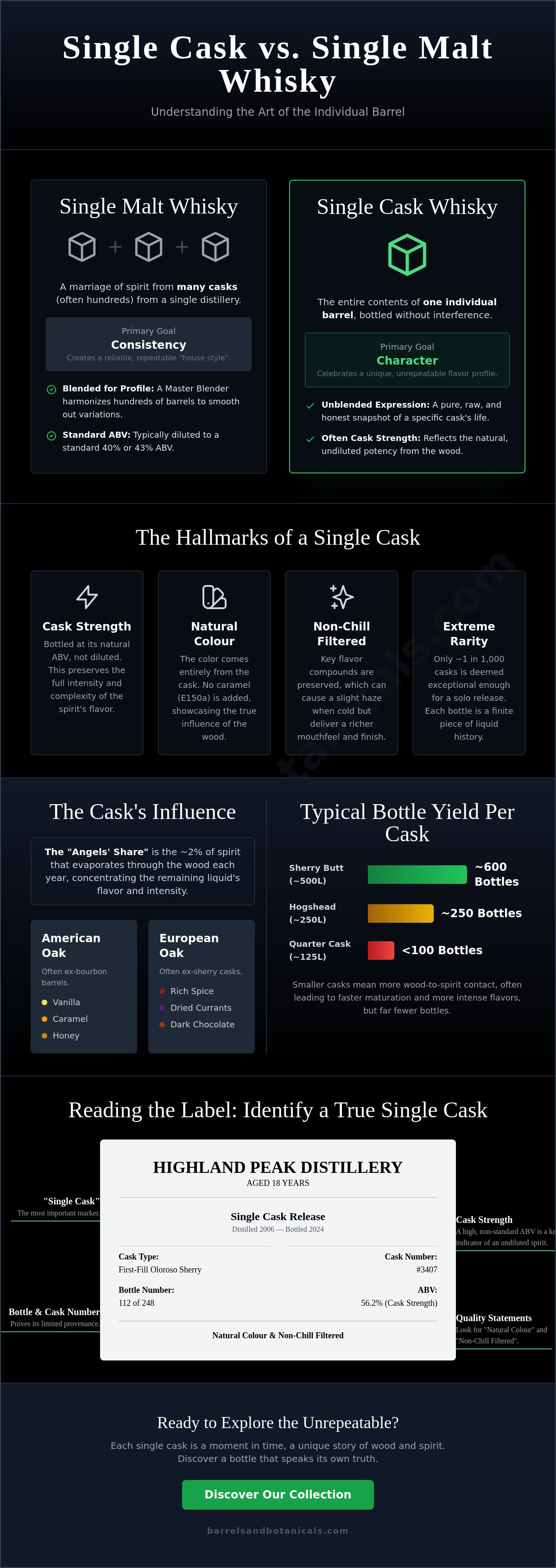
It's the liquid captured in its most raw, honest state. While most commercial Scotch is diluted with water to a standard 40% or 43% ABV, single cask expressions are often left at "cask strength," reflecting the natural potency of the wood. The Master Blender acts as a curator rather than a chemist, selecting only the most exceptional casks that possess a character too distinctive to be hidden in a blend. Because Single barrel whiskey represents such a narrow selection, it offers the most authentic expression of a distillery's craft. Pure. Unfiltered. Unrepeatable.
Selecting these casks is a rigorous ritual. Only about 1 in every 1,000 casks might be deemed "standout" enough for a solo release. This scarcity drives the premium nature of the spirit, turning every bottle into a collector's piece that celebrates the specific marriage of grain, water, and wood.
The Anatomy of the Barrel
The wood dictates the destiny of the spirit. American oak barrels, often sourced from the bourbon industry, impart vibrant notes of vanilla, caramel, and honey. European oak, frequently used for Sherry maturation, provides a deeper hue and a palate of rich spice and dried currants. Cask seasoning is the process of pre-filling a barrel with wine or spirits to prepare the wood and imbue it with foundational flavor characteristics. Whether it's the nutty residue of an Oloroso Sherry or the punchy sweetness of a Port pipe, the previous inhabitant of the wood defines the final nuanced profile.
A Snapshot in Time
Environment is an invisible ingredient. A cask resting near a damp stone wall in a traditional dunnage warehouse matures differently than one stacked in a modern racked facility. These micro-maturations are influenced by local humidity and temperature shifts. In the United Kingdom, the "Angels' Share" accounts for approximately 2% of the liquid evaporating through the wood each year. This natural loss concentrates the essence, leaving behind a more intense and complex spirit. Once a 250-litre hogshead is emptied and bottled, that exact flavor profile is gone forever. It's a fleeting moment of liquid history.
Single Cask vs. Single Malt: Understanding the Distinction
A common confusion exists in the world of fine spirits. To understand what is single cask whisky, one must first look at the broader category of single malt. A single malt is the product of one distillery, but it's typically a marriage of hundreds of barrels. The master blender acts as a conductor, harmonizing disparate notes into a consistent house style. Single cask whisky is the solo performance. It's the contents of one individual barrel, bottled without interference. Every single cask is a single malt, but very few single malts qualify as single casks.
While a standard 12-year-old expression aims for the same profile year after year, the single cask celebrates the beautiful outlier. It’s a spirit that defied the expected trajectory. Production volumes are naturally tiny. A standard Sherry butt might yield 600 bottles, while a smaller quarter cask could produce fewer than 100. This inherent rarity dictates the price point. In the UK market, these bottles often start at £80 and climb into the thousands for aged rarities. You aren't just buying liquid; you're securing a finite moment in time.
Consistency vs. Character
Traditional blending smooths out the edges. It removes the sharp peaks of a particularly aggressive barrel to ensure a reliable taste for the casual drinker. For the connoisseur, those edges are the prize. A single cask might offer an unexpected explosion of dark chocolate or a sudden, vibrant burst of sea salt that would be lost in a large vatting. Connoisseurs often seek out these perceived flaws. They crave the intensity of an unblended spirit. It's a raw, honest reflection of wood and time. The ritual of the pour becomes an exploration of smoke, fruit, or spice that no blender could ever replicate.
The Independent Bottler’s Role
Distilleries often focus on their core range. Independent houses like Signatory Vintage or Gordon & MacPhail step in to curate the exceptional. They source specific casks, often letting them age in their own warehouses to achieve a specific essence. These labels carry immense prestige. They offer a window into a distillery's soul that official bottlings might hide. If you're looking to buy rare scotch online UK, these independent releases are often the most sought-after treasures. They represent a curated choice for quality over mass appeal. Exploring these labels is the best way to truly grasp what is single cask whisky and why it commands such respect.
The Sensory Journey: Why Connoisseurs Seek the Unblended
To truly understand what is single cask whisky, you have to look past the label. It's the liquid in its most unadulterated state. No blending. No dilution. No compromise. It's a snapshot of a specific moment in time, captured within the staves of a single oak barrel. For the enthusiast, this represents the pinnacle of the craft, offering a sensory depth that mass-produced expressions simply cannot replicate.
Most commercial bottles are diluted with water to a standard 40% or 43% ABV. Single casks are different. They're often presented at cask strength, frequently ranging from 52% to 64% ABV. This is the spirit exactly as it emerged from the wood. It's powerful. It's raw. It's honest. Every bottle also carries the badge of natural colour. Premium releases strictly forbid E150a caramel additives, meaning the deep mahogany or pale straw hue in your glass is 100% the result of years spent in a Scottish warehouse.
The texture is equally vital. Standard whiskies undergo chill-filtration to ensure they don't turn cloudy when ice is added. However, this process removes essential fatty acids and esters. Single cask spirits are almost always non-chill filtered. This preserves a rich, oily mouthfeel that coats the tongue, carrying flavours further and deeper into the palate. It's a tactile experience as much as a flavourful one.
- Cask Strength: Pure intensity, delivered without dilution.
- Natural Colour: Authenticity in every shade, free from artificial dyes.
- Non-Chill Filtered: A heavy, luxurious mouthfeel that retains every ester.
- The Water Ritual: Using a single drop of water to break surface tension and release hidden aromatics.
Nose, Palate, and Finish
The aromatics of a single cask are vibrant and concentrated. You might find notes of scorched citrus, damp earth, or toasted manuka honey that feel more alive than in a blended malt. Because of the high proof, the palate weight is substantial; it feels heavy and deliberate on the tongue. The finish of a single cask lingers with artisanal complexity, evolving through layers of spice and sweetness that remain long after the final sip.
The Ritual of Consumption
Preparation is part of the pleasure. Choosing the right glassware, such as a Glencairn or a tulip-shaped copita, is essential to concentrate the delicate botanical notes. This is the essence of mindful drinking. You're savouring the history of a single barrel, acknowledging the decades of evaporation known as the Angel's Share. While these spirits are magnificent neat, bold single casks possess the structural integrity to stand up to classic cocktails or a hand-rolled cigar. It's about the quality of the moment, not the quantity of the pour.
Rarity, Provenance, and the Value of the Unrepeatable
The allure of the single cask lies in its finite nature. Unlike mass-produced spirits that aim for consistency, these releases celebrate the unique. The mathematics of rarity is simple but profound. A standard hogshead cask, holding roughly 250 litres, typically yields between 200 and 300 bottles after accounting for the "angels' share" lost to evaporation. This finite quality is the defining answer to what is single cask whisky; it is a liquid snapshot of a specific moment in time that can never be replicated. Once the final bottle is uncorked, that specific profile vanishes from the world forever.
Bottle numbering adds a layer of intimacy and collectibility. Seeing "Bottle 14 of 212" on a label creates an immediate connection to the craft. It isn't just a product; it's a piece of a specific oak vessel's history. This scarcity drives the investment angle. In the UK market, single casks have historically outperformed blended malts. Data from the Knight Frank Luxury Investment Index 2023 indicates that rare whisky has seen a ten-year growth of 373%, far outstripping many traditional asset classes. Provenance provides the security for this value. Every bottle traces back to a specific distillation date, a precise warehouse location, and a unique cask number.
- Distillation Date: The exact day the spirit met the copper.
- Warehouse Location: The micro-climate that influenced the wood.
- Cask Type: Whether it was seasoned with Oloroso sherry or charred American oak.
The Secondary Market and Brokerage
Rare single casks are often described as "liquid gold" by those within the industry. Their value fluctuates based on distillery prestige and the specific nuances of the wood. Specialized shops and brokers play a critical role in this ecosystem, acting as gatekeepers who authenticate labels, seals, and fill levels. For enthusiasts looking to sell my whisky collection Scotland, the market for these unrepeatable expressions remains incredibly buoyant. Authenticity is the currency of the secondary market.
Spotting a Future Classic
Identifying a high-value release requires a keen eye for the "vintage" markers. While age is important, the distillery’s reputation and the cask's previous contents are the true architects of value. Sherry butts often command higher premiums than standard bourbon barrels due to their rich colour and depth. Understanding what is single cask whisky requires looking past the brand to the "fill date" and "bottling date." These dates transform a bottle into a historical document, capturing the essence of a specific year's harvest and peat smoke profile.
Discover the art of mindful selection and elevate your home bar with our curated collections. Explore the Barrels and Botanicals range today.
Curating Your Collection: How to Source Exceptional Single Casks
Sourcing a bottle is an intentional act of curation. You aren't just buying a drink; you're acquiring a specific, unrepeatable moment in time. When asking what is single cask whisky, the answer often lies in the technical markers found on the label. Look for "Cask Strength" and "Non-chill filtered" as your primary indicators of quality. Cask strength spirits typically sit between 50% and 60% ABV, offering a raw, powerful expression of the wood. Non-chill filtering ensures the natural fatty acids and esters remain in the liquid. These elements provide the creamy, mouth-coating texture that defines a premium experience.
Understanding the "distillate character" is equally vital. Every distillery has a genetic code. Some produce heavy, oily spirits while others focus on light, grassy notes. A single cask highlights this DNA rather than masking it. If you seek immediate sensory impact, look for smaller vessels. Quarter casks hold approximately 50 litres, and octaves contain roughly 50 to 60 litres. Because these are significantly smaller than a standard 200-litre American Standard Barrel, the spirit has more contact with the wood. This results in an accelerated, intense infusion of flavor. Bold spice. Deep oak. Pure character.
Reading the Label Like an Expert
The label is a map of the spirit's journey. Decoding "First-fill" versus "Refill" is your first step. First-fill casks are active and vibrant, having only held bourbon or sherry once before. They impart loud notes of vanilla, caramel, or dried fruits. Refill casks are more subtle; they've been used multiple times and allow the distillery's own essence to shine through. Always identify the specific cask number. This is a unique fingerprint. You can use this number to check global databases like Whiskybase, where over 2 million bottle entries provide peer reviews and historical ratings. While a high ABV might seem intimidating, it acts as a carrier for complex aromatics. A single drop of water can open these layers, revealing hidden botanicals and oils.
The Barrels & Botanicals Experience
Our family-run expertise helps you navigate the complex world of Scottish malts with clarity and passion. We move away from mass-produced consistency to focus on the gain of unique, artisanal flavors. Our commitment involves sourcing small-batch spirits that possess genuine soul and a sense of place. We value the ritual of the pour, treating every bottle as a curated choice for quality and mindful enjoyment. We invite you to visit our whisky shop online or in-person for tailored advice. Discover a selection where the absence of compromise leads to a more refined, intentional drinking experience. Sophisticated tastes. Expertly sourced. Truly singular.
Begin Your Journey Into the Singular
To truly grasp what is single cask whisky, you must look past the blended consistency of the high street and toward the raw, unadulterated spirit. It's a liquid snapshot of time. One barrel. One distillery. One chance to taste a profile that'll never exist again. You've explored the nuance of the wood and the rarity of the provenance. Now, it's about the ritual of the pour.
Barrels and Botanicals operates as a family-owned specialist, offering expert brokerage services for the most discerning collectors. We curate rare, old, and unrepeatable Scottish spirits that define the peak of artisanal distillation. Our expertise doesn't stop at the warehouse doors; we also source small-batch gins and artisanal beers for the modern epicurean. Each bottle is a testament to mindful craftsmanship and complex flavor. Whether you're seeking a vibrant Highland malt or a deep, peated Islay, the focus remains on the gain of sensory experience.
Explore our curated collection of rare Single Cask Whiskies and secure a piece of liquid history for your private cellar. Savor the essence of the extraordinary.
Frequently Asked Questions
Is single cask whisky always better than single malt?
Single cask whisky isn't inherently better than single malt, but it offers a more singular and unrepeatable experience. While a standard single malt involves blending hundreds of casks to achieve a consistent house style, a single cask expression celebrates the unique personality of one specific barrel. You trade the reliability of a core range for the raw, unfiltered essence of a single maturation journey. It's a choice between a masterfully conducted orchestra and a captivating solo performance.
Why is single cask whisky usually bottled at cask strength?
Bottling at cask strength preserves the full intensity and texture developed during years of maturation. Most commercial whiskies are diluted with water to 40% or 43% ABV to increase volume and soften the palate. In contrast, what is single cask whisky often delivers a potent 55% to 62% ABV. This high proof maintains the essential oils and esters that provide a rich, viscous mouthfeel and a more complex aromatic profile.
How many bottles do you typically get from a single cask?
A standard 200 litre American Standard Barrel typically yields between 220 and 280 bottles after the "angel's share" evaporation. Larger 500 litre Sherry Butts can produce up to 600 bottles. These numbers fluctuate based on the age of the spirit and the climate of the dunnage warehouse. Every bottle is a finite treasure. Once the specific cask is emptied, that exact flavour profile can never be recreated.
Does single cask whisky expire or go bad once opened?
Whisky doesn't expire in the traditional sense, but oxidation begins to alter the flavour profile once the seal is broken. If the bottle is more than half full, the spirit remains vibrant for approximately 12 to 24 months. As the liquid level drops, the increased oxygen surface area accelerates the fading of delicate top notes. To preserve the ritual, keep your bottle in a cool, dark place away from direct sunlight.
Can I add water to a single cask whisky?
Adding a few drops of filtered water is highly recommended to "open up" the spirit and release hidden aromatics. Because these whiskies are often bottled at high proof, the water breaks the surface tension and reduces the alcohol burn. This allows nuanced notes of dried fruit, spice, or coastal salt to emerge on the palate. Use a pipette to add water incrementally, tasting after each drop to find your perfect balance.
What is the difference between a single cask and a single barrel?
The difference is primarily linguistic and rooted in regional traditions rather than production methods. In Scotland and Ireland, producers use the term "single cask" to describe spirit from one vessel. Distillers in the United States typically use "single barrel" for their bourbon and rye releases. Both terms signify that the bottle's contents originated from one individual maturation unit without being blended with other stocks.
Why is there no caramel colouring in most single cask whiskies?
Single cask whiskies avoid E150a caramel colouring to maintain the integrity of the natural maturation process. Large scale brands use spirit caramel to ensure every bottle on a supermarket shelf looks identical. Purists believe this masks the true character of the wood. By presenting the whisky in its natural hue, distillers allow you to see the honest impact of the oak, whether it's a pale straw or a deep mahogany.
Are single cask whiskies a good investment for beginners?
Single cask whiskies can be excellent investments due to their inherent scarcity and the finite nature of the release. Data from the Knight Frank Rare Whisky Index shows that certain collectable bottles have seen growth over the last decade. For a beginner, focusing on established distilleries like Macallan or Springbank is a safer entry point. Always check the bottle number and total outturn to ensure you're buying a truly limited piece of liquid history.