
What if the most prestigious number on your shelf isn't a score of quality, but simply a measure of patience? You've likely stood before a mahogany-clad display, debating whether a twenty-year-old malt justifies its premium over a vibrant ten-year-old expression. It's a common dilemma. Many enthusiasts feel a lingering anxiety that they're overpaying for a label or missing out on the nuances of the youngest spirit hidden within a blend. Understanding whisky age statements is about more than just counting years. It's about deciphering the silent dialogue between charred oak and maturing spirit. Honeyed notes. Toasted spice. The slow, rhythmic breath of the barrel.
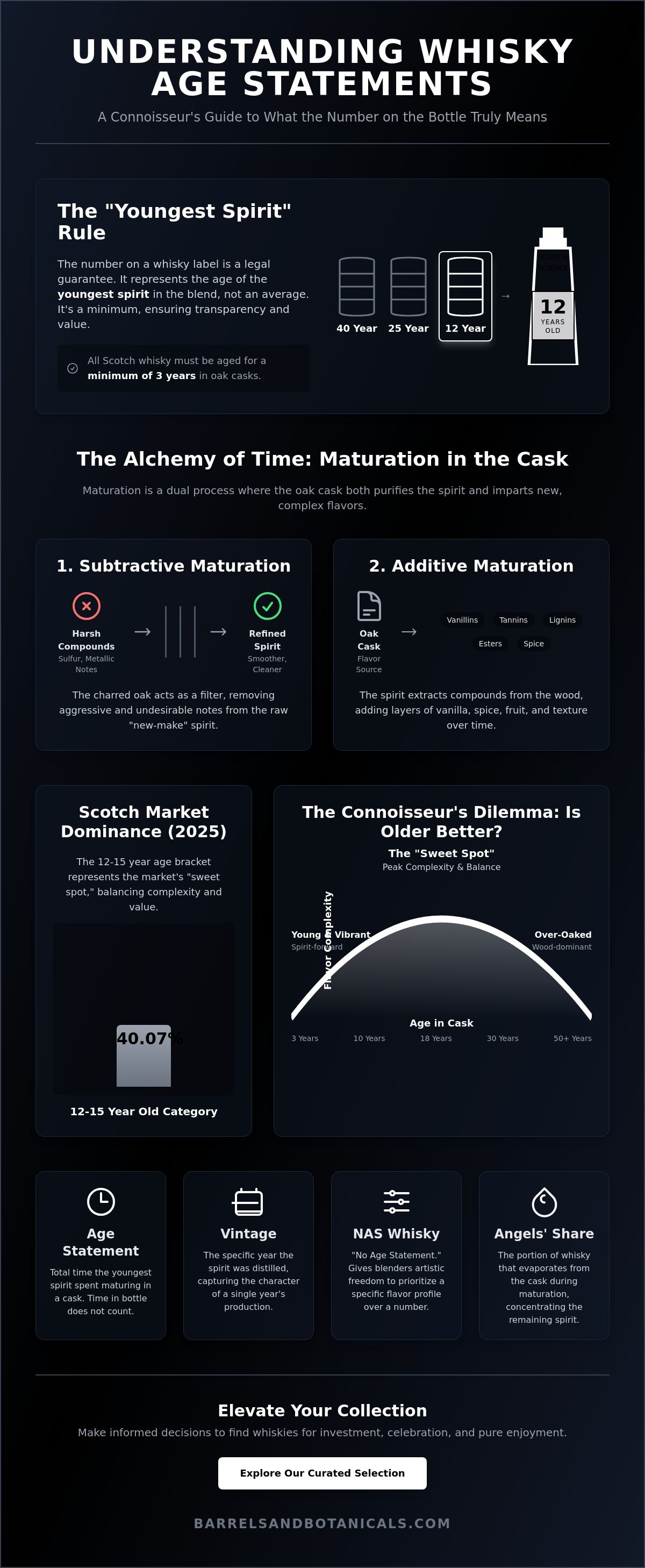
We'll unlock the secrets behind those digits to help you distinguish genuine craftsmanship from mere marketing hype. You'll learn how to read a label with the precision of a master blender and understand why the 12-15 year category dominated 40.07% of the Scotch market in 2025. This guide explores the evolving landscape of global regulations, including the 2025 UK cask ownership updates and US labeling shifts, ensuring you make informed decisions for your personal collection. We'll examine the influence of the angels' share and the specific alchemy of cask finishing. We're moving beyond the numbers to celebrate the liquid itself.
Key Takeaways
- Decode the "youngest spirit" rule to gain a more sophisticated perspective on understanding whisky age statements and what those numbers truly signify on the label.
- Explore the dual alchemy of maturation, where oak casks subtract harsh impurities and add layers of complex spice, vanillin, and rich texture.
- Recognize the "sweet spot" of aging for various distilleries to ensure you're investing in a balanced spirit rather than a bottle that's been over-oaked.
- Demystify the rise of No Age Statement (NAS) whiskies to appreciate how master blenders use a variety of vintages to achieve a curated, artisanal flavor profile.
- Elevate your collection by identifying which bottles serve as blue-chip investments and which are best reserved for the ceremony of a shared celebration.
The Legalities of the Label: What the Number Truly Represents
The weight of a whisky bottle in your hand is more than just glass and liquid. It's a testament to time. When you begin the journey of understanding whisky age statements, you're looking at a legal promise. The legal framework governing your glass is rooted in the 2009 Scotch Whisky Regulations, a set of rules designed to preserve the integrity of the craft. These laws ensure that when a label says "12 years," it represents a minimum, never an average. It's a floor, not a ceiling. This "youngest spirit" rule means that even if a master blender marries a vibrant 12-year-old malt with a rare, velvet-textured 40-year-old spirit, the bottle must still wear the younger number. It's a system built on transparency. It protects you from marketing sleight-of-hand and ensures the price you pay reflects the youngest drop in the blend.
Every bottle of Scotch must also respect the three-year minimum. No spirit can legally call itself Scotch whisky until it has rested for at least three years in oak. This duration isn't arbitrary. It's the threshold where the raw, fiery "new-make" spirit begins to shed its metallic edges and adopt the character of the wood. You might notice that some spirits are bottled without an age statement at all. These are known as NAS whiskies. While they still meet the three-year legal requirement, they trade the prestige of a number for the artistic freedom of the blender. However, remember that time in the bottle is static. Unlike wine, whisky doesn't continue to age once it leaves the cask. A 12-year-old bottle tucked away in a cellar for twenty years remains a 12-year-old whisky. The alchemy happens only within the wood.
The Definition of Maturation
Maturation is the transformative dialogue between spirit and oak. This process only occurs while the liquid is in contact with the barrel. The spirit-to-wood ratio is vital here. In smaller casks like octaves or quarter casks, the liquid has more surface contact with the wood, accelerating the extraction of flavors. Larger puncheons or butts offer a slower, more patient maturation. As the spirit rests, it inhales the surrounding air and exhales the "angels' share," a slow evaporation that concentrates the remaining liquid. It's a physical exchange where the wood acts as both a filter and a spice cabinet.
Decoding the Age Statement
Differentiating between age and vintage is a hallmark of the true connoisseur. An age statement tells you the duration of time spent in the cask. A "Vintage" statement, however, tells you the specific year the spirit was distilled. Single malts often carry an age statement to showcase the consistency of a distillery's profile. Blended malts use them to highlight the harmony achieved between different houses. You'll often find that distilleries include older, more expensive whiskies in a younger-stated bottle to add depth and "bass notes" to the flavor profile. They do this to ensure the final product meets a specific sensory standard, even if the law forbids them from bragging about the older components on the front label.
The Alchemy of Time: How Age Shapes the Sensory Experience
Inside the quiet darkness of a bonded warehouse, a silent revolution occurs. While the legalities define the label, the liquid itself undergoes a profound transformation that science can only partially explain. Beyond the simple passage of years, understanding whisky age statements requires an appreciation for the two-way conversation between the spirit and the wood. This process is both subtractive and additive. The charred interior of an oak cask acts as a biological filter, stripping away the aggressive, metallic, and sulfurous "new-make" notes that define a raw distillate. It refines the spirit. It polishes the edges. What remains is a clean canvas, ready for the cask to leave its mark.
The additive process is where the sensory magic truly begins. Over decades, the spirit coaxes vanillins, tannins, and lignins from the oak staves. These compounds introduce creamy textures, structural dryness, and complex sweetness. Simultaneously, a slow dance of oxidation takes place. Oxygen seeps through the porous wood, encouraging the formation of esters. These are the compounds responsible for the ethereal notes of dried apricot, tropical fruit, and old roses. However, a darker hue does not always signal a more venerable spirit. Color is often a byproduct of the cask's previous life or the addition of spirit caramel (E150a) for consistency. A pale, straw-colored 18-year-old can often possess a more intricate flavor profile than a dark, sherry-heavy 10-year-old.
Primary Cask Influence
The choice of timber dictates the spirit's destiny. Ex-Bourbon casks, crafted from American white oak, typically impart notes of coconut, honey, and bright vanilla. In contrast, Ex-Sherry casks from European oak offer a darker, more brooding profile of clove, raisin, and leather. The "fill" of the cask is equally vital. A first-fill cask is potent and active, maturing the spirit with assertive speed. A refill cask, having given much of its character to a previous occupant, allows the distillery's unique spirit character to shine through with more subtlety. To experience these nuances firsthand, you might choose to explore a curated selection of single malts that highlight the distinct impact of specific wood finishes.
The Angels’ Share
Time is a demanding creditor. Each year, roughly 2% of the whisky in a Scottish cask evaporates through the wood. This "angels' share" is more than just a loss of volume; it's a concentration of excellence. As water and alcohol escape, the remaining liquid becomes more concentrated and viscous. In warmer climates, like the warehouses of Kentucky where 16.1 million barrels of bourbon rested in 2025, this process accelerates significantly. By the time a Scotch reaches 25 or 30 years of age, the rarity is defined not just by the years, but by the small, precious amount of liquid that the heavens allowed to remain.
The Connoisseur’s Dilemma: Is Older Always Better?
A 30-year-old bottle commands immediate respect. It carries a hefty price tag and a sense of historical gravity. But does the liquid always live up to the prestige? When you're understanding whisky age statements, you must eventually confront the law of diminishing returns. Every distillery has a peak. There's a specific moment where the spirit and wood exist in perfect, harmonious equilibrium. Beyond this point, the cask can become an aggressor. It begins to mask the delicate orchard fruits or the crisp maltiness of the original distillate with heavy tannins and dry, bitter wood spice. The result is a dram that feels tired rather than refined.
Over-oaking is the primary risk of long-term maturation. A spirit that has spent three decades in an active first-fill cask might emerge tasting more like a sawmill than a scotch. It loses what blenders call its "distillery character." The vibrant, citrusy zing of a 10-year-old can often provide a more refreshing and sensory-rich experience than a 40-year-old that's been smoothed into anonymity. Choosing a bottle isn't about finding the highest number. It's about deciding whether you crave the spirited, fiery energy of youth or the soft, parchment-dry wisdom of a long-rested malt.
The Sweet Spot of Maturation
The ideal age varies significantly by style and region. Peated whiskies from Islay often find their sweet spot early in their lifecycle. Between 8 and 12 years, the smoke is bold, medicinal, and punchy. As these whiskies age into their twenties, that peat smoke mellows into a soft, campfire ember. While some enjoy this subtlety, others find it lacks the distillery's signature intensity. Conversely, unpeated Speysides may need 18 years or more to fully develop their honeyed, floral complexity. To truly test your palate, seek out cask-strength bottlings. These high-proof expressions preserve the essential oils and esters that dilution can sometimes dull, allowing the age-related depth to shine through with uncompromising clarity.
The Value Proposition
High prices don't always guarantee a superior tasting profile. Often, the cost reflects rarity, the "angels' share" loss, and the overhead of storage over decades. Yet, there's an undeniable allure to tasting a liquid that was distilled in a different era. We encourage you to explore rare and old whisky as a way to connect with liquid history. Treat the experience as an educational ritual. Age is a narrative of history, while flavor is a narrative of craft. One offers a window into the past; the other offers the direct sensory pleasure of the present moment.
No Age Statement (NAS): A Modern Artisanal Perspective
While the traditionalist often clings to the comfort of a number, the modern epicurean understands that silence can be equally expressive. No Age Statement (NAS) whiskies are often misunderstood as a mere response to dwindling stocks. This perspective is limited. In the hands of a master professional, removing the number is a liberation. It allows for a focus on a curated flavor profile rather than a chronological constraint. When you're understanding whisky age statements, you'll find that NAS releases frequently represent the pinnacle of a distillery's creative blending. They aren't a compromise; they're a signature.
The true power of an NAS bottle lies in the blending advantage. A master blender can marry the vibrant, citrus-led "punch" of a five-year-old spirit with the velvet depth and leather-bound wisdom of a thirty-year-old malt. By removing the legal requirement to state the youngest age, the blender can use a small percentage of youthful spirit to provide structural brightness without devaluing the older components on the label. It shifts the conversation from the calendar to the palate. You're no longer drinking a number. You're drinking a deliberate, sensory experience designed for immediate pleasure. It's about the harmony of the final liquid.
Creativity Without Constraints
Distilleries use NAS to maintain a consistent house style that transcends the variability of individual vintages. Iconic releases from prestigious houses have proven that complexity doesn't require a decade-count. These bottlings often feature unique cask finishes or rare experimental batches that wouldn't fit into a standard age-bracketed range. Transparency remains key. Many artisanal producers now provide detailed information regarding the types of wood used and the flavor goals of the blend, even if the specific ages remain a secret. It's an invitation to trust your senses over your expectations.
NAS vs. Age Statement: A Comparison
The choice between an age statement and an NAS bottle often comes down to your personal ritual. Age statements offer consistency and a tangible sense of prestige. They are the "blue chips" of the collection. NAS whiskies, however, represent innovation and a focus on pure flavor. Some collectors remain skeptical, fearing they're paying more for younger liquid. Overcome this bias by focusing on the texture and finish. Younger, bolder NAS expressions often possess a spirited intensity that makes them ideal for classic cocktails, where their character can stand up to other ingredients. If you're ready to expand your horizons, explore our collection of artisanal whiskies to find your next favorite NAS expression.
Curating Your Collection: Age as a Factor in Value and Ritual
Building a whisky collection is an act of intentional curation. It's a gallery of time. While your journey began with understanding whisky age statements from a technical perspective, the final stage is understanding their role in the ceremony of ownership. A sophisticated bar requires a thoughtful balance. It needs the spirited energy of craft beers and vibrant young malts for casual gatherings. It demands the "blue chip" prestige of venerable age statements to anchor the collection. These older expressions are the crown jewels. They represent a finite resource. With the global whisky market reaching a value of USD 92.89 billion in 2025, the demand for these liquid assets has never been more pronounced. They are the survivors of the angels' share. Rare. Concentrated. Historically significant.
The secondary market views age as the ultimate currency of rarity. While a blender’s skill in an NAS bottle is admirable, the market rewards the patient passage of decades. Age statements provide a verifiable benchmark for investors. They are the primary drivers of resale value in a landscape where scarcity dictates price. To build a balanced bar, consider these categories:
- The Daily Dram: 10 to 12-year-old expressions that offer distillery consistency.
- The Conversation Piece: High-quality NAS bottlings that showcase artisanal blending.
- The Investment Grade: 25-year-old plus bottlings with documented provenance.
- The Independent Bottling: Single cask releases that offer a unique snapshot of a specific year.
Investing in Time
The allure of a 30 or 50-year-old bottling lies in its impossibility. You can't manufacture time. Independent bottlers play a crucial role here, often releasing "hidden gems" from famous distilleries that have matured beyond the standard house style. These bottles often appreciate as the original distillery stocks are depleted. However, every collection has a life cycle. Knowing when a bottle has reached its peak market value is a skill in itself. If you're looking to refine your portfolio, you may want to explore the professional process of selling your whisky collection to ensure your investments are realized at the opportune moment.
The Ultimate Ritual
Consumption should be a ceremony, not a habit. An aged dram deserves a specific moment of intentionality. Slow down. Observe the legs on the glass. Appreciate the deep, mahogany hues. To truly elevate the experience, many connoisseurs pair a long-matured Scotch with the rich, earthy complexity of a premium cigar. The interplay between the charred oak of the cask and the toasted leaf of a Cuban or New World cigar creates a sensory dialogue that is unparalleled. It's a celebration of craftsmanship. We invite you to visit our rare scotch destination to find the next centerpiece for your collection. Choose with patience. Drink with respect.
Elevating Your Private Collection
True mastery of your bar comes from seeing the bottle as a vessel of history. It's more than a chronological record. You've moved beyond the surface level of understanding whisky age statements to appreciate the intricate dialogue between the spirit and the charred oak. Whether you're drawn to the vibrant energy of a craft NAS or the velvet wisdom of a long-rested single malt, the choice is now a curated preference. It's about finding that perfect equilibrium where the distillery's character shines through the wood's influence. Each pour is a celebration of the blender's art and the forest's gift.
As you continue to build your repertoire, remember that every dram tells a story of patience and artisanal skill. Our family-run connoisseur service acts as your knowledgeable guide. We specialize in old and rare single malts, providing expert brokerage for those truly exceptional bottles that define a collection. Discover our curated collection of rare and aged whiskies and find the next hero of your personal ritual. The world of refined taste is vast. Your next great discovery is waiting to be uncorked.
Frequently Asked Questions
Does whisky keep ageing once it is in the bottle?
No, maturation stops the moment the spirit is separated from the wood and sealed in glass. Unlike other beverages that evolve through slow oxidation in the bottle, whisky is a finished product once it leaves the cask. A bottle labeled as twelve years old remains a twelve-year-old spirit even if you keep it for half a century. The glass acts as a permanent barrier to the elemental changes found in the warehouse.
Why is a 12-year-old whisky sometimes more expensive than an 18-year-old?
Pricing is often dictated by the rarity of the distillery and the specific activity of the casks rather than the age statement alone. A 12-year-old expression from a "silent" distillery or one matured in a rare, first-fill Oloroso sherry butt often commands a higher price than a mass-produced 18-year-old. Collectors pay for the scarcity of the liquid and the intensity of the flavor profile. It's about the value of the experience.
What is the youngest a Scotch whisky can legally be?
Scotch whisky must be matured for a minimum of three years in oak casks on Scottish soil. This is the legal threshold established to ensure the spirit has shed its raw, cereal-heavy "new-make" character. While many distilleries wait much longer to release their malts, this three-year rule is the foundation of the industry's integrity. It ensures every bottle carries the weight of tradition and meets a baseline of quality.
Does a dark color always mean the whisky is old?
Color is an unreliable indicator of age because it is primarily influenced by the type of wood and the previous contents of the cask. An 18-year-old whisky matured in a refill bourbon barrel will often be much lighter than a 10-year-old matured in a first-fill sherry cask. Some producers also use spirit caramel to ensure a consistent appearance across batches. Always trust your palate and the label over your eyes.
Are No Age Statement (NAS) whiskies lower quality?
No Age Statement whiskies aren't inherently lower in quality; they simply prioritize a specific flavor profile over a chronological number. These expressions allow master blenders to use a diverse palette of casks to achieve a curated "house style" that is consistent year after year. By removing the age constraint, they can focus on the sensory harmony of the liquid. Many premium and award-winning single malts are released as NAS expressions to celebrate this artisanal freedom.
What happens if a distillery mixes a 10-year-old and a 20-year-old whisky?
The bottle must legally carry the age of the youngest spirit in the blend. If a distillery marries a 10-year-old malt with a 20-year-old, the label must state "10 years." This transparency is a core part of understanding whisky age statements. It protects the consumer by ensuring the number represents the minimum guaranteed maturity of every drop inside the glass, regardless of how much older liquid is included.
What is the "Angels’ Share" in whisky maturation?
The "Angels' Share" is the natural evaporation of alcohol and water through the porous oak of the cask during maturation. In the temperate Scottish climate, this loss is approximately 2% of the volume each year. This process concentrates the flavors and creates the rich, oily texture found in older drams. It's a sacrificial exchange that transforms the spirit into a complex masterpiece, making long-matured whiskies both rarer and more intense.
How should I store an old bottle of whisky to preserve its age?
Store your bottles upright in a cool, dark environment away from direct sunlight and extreme temperature fluctuations. Unlike other corked beverages, whisky corks shouldn't remain in constant contact with the high-proof spirit, as the alcohol can degrade the material over time. Keeping the bottle in its original box provides an extra layer of protection against light. This simple ritual ensures the integrity of your curated collection remains intact for years to come.