
Imagine standing before a wall of amber glass, caught between the rugged allure of the Highlands and the maritime mystery of the Islands. It's easy to feel overwhelmed by the sheer volume of choices and the subtle differences that separate a Speyside orchard from a Lowland meadow. By understanding scotch whisky regions, you transform a daunting selection into a curated sensory ritual. You deserve to move beyond the label and into the liquid essence of the landscape.
We believe these regions are the botanical blueprints for your palate. Whether you're drawn to the grass-fed delicacy of a southern malt or the medicinal intensity of the west, mastering these boundaries is the key to a balanced home collection. This guide navigates the official territories and the hidden histories that define their profiles. Prepare to decode the nuances of the nose, palate, and finish as we map the soul of the dram. It's time to ensure your next purchase is an intentional choice for quality and sensory gain.
Key Takeaways
- Explore how environmental "terroir"—the interplay of coastal air, local water sources, and ancient peat—shapes the distinct soul of every Scottish dram.
- Contrast the vast, heather-honeyed profiles of the Highlands with the dense, orchard-fruit elegance found in the Speyside "Garden of Scotland."
- Uncover the sophisticated floral notes of the Lowlands and the rare, industrial character of Campbeltown to add unexpected depth to your collection.
- Master the art of understanding scotch whisky regions by learning to identify the signature medicinal salt and campfire smoke that defines Islay’s legendary malts.
- Elevate your home tasting ritual with expert guidance on selecting glassware and using water drops to unlock hidden botanical essences within the glass.
The Geography of Flavour: Why Scotch Whisky Regions Matter
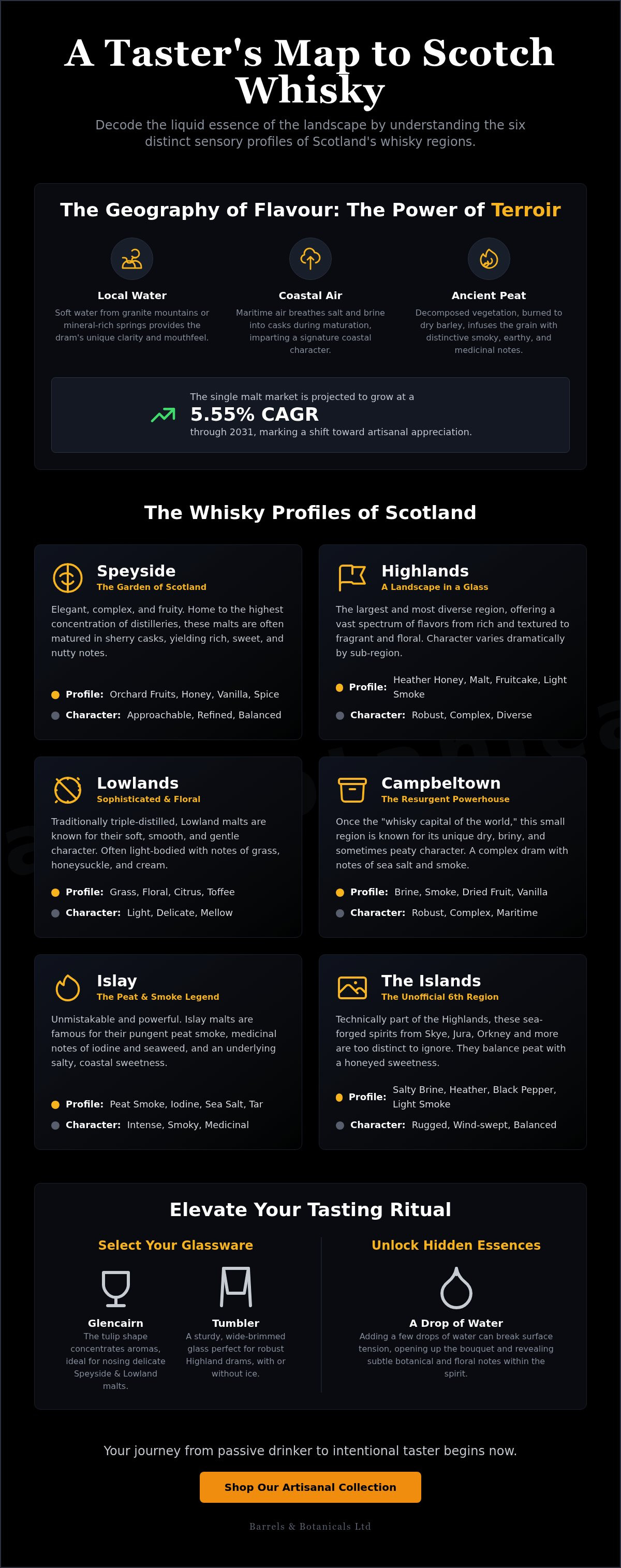
To the uninitiated, a bottle of Scotch is simply a spirit. To the epicurean, it is a liquid map. The Scotch Whisky Association (SWA) established the Scotch Whisky Regulations in 2009 to protect this heritage, codifying five distinct territories that define the industry. These are Speyside, the Highlands, the Lowlands, Islay, and Campbeltown. Each name acts as a protected geographic indication. This ensures that the liquid inside reflects the specific environment of its birth, preventing the dilution of regional identity in a global market.
This is the essence of terroir. In the world of fine spirits, terroir describes how the local environment, water, air, and soil, dictates the final character of the dram. Soft water filtered through Highland granite yields a different clarity than the mineral-rich springs of the Lowlands. The coastal air doesn't just surround the distillery; it breathes into the casks during maturation. By understanding scotch whisky regions, you begin to see these bottles as more than alcohol. They are capsules of time and place. This knowledge marks your transition from a passive drinker to an intentional taster. It's a valuable skill, especially as the single malt market is projected to grow at a compound annual growth rate of 5.55% through 2031. You're not just buying a bottle; you're investing in a sensory legacy.
Beyond the Map: The Sensory Blueprint
Regionality is your first clue to the nose and palate of a spirit. Before the cork is even pulled, the region suggests a profile. While the industry once focused heavily on mass-produced blends, the modern connoisseur celebrates the single malt for its regional purity. It's a shift toward artisanal appreciation. A Scotch Whisky Region is a botanical fingerprint of the Scottish landscape. Mastering the nuances of these territories is the first step in understanding scotch whisky regions as more than just lines on a map. This fingerprint informs every ritual, from the choice of glassware to the specific drop of water used to open up the bouquet.
The Debate of the Sixth Region: The Islands
While the SWA recognizes five official Scotch whisky regions, the Islands often occupy a sixth space in the hearts of enthusiasts. Technically, these distilleries fall under the Highland classification. However, the maritime character of malts from Skye, Orkney, and Jura is too distinct to ignore. These are spirits forged by the sea. They carry a vibrant saltiness and a rugged, wind-swept essence that differs from the mainland Highland malts. Treating the Islands as a separate ritual acknowledges the unique botanical and environmental influences of these remote, artisanal outposts.
Highland Grandeur and the Speyside Epicentre
The Highlands and Speyside represent the dual heart of Scottish distillation. One offers a rugged, sweeping grandeur while the other provides a refined, epicurean epicenter. To truly begin understanding scotch whisky regions, you must appreciate the tension between these two neighbors. The Highlands cover the largest geographical area in Scotland. Conversely, Speyside, nestled within its eastern borders, boasts the highest concentration of distilleries in the world. This density isn't just a matter of logistics. It's a testament to the "Garden of Scotland," where fertile soil and the River Spey create a lush, botanical foundation for some of the world's most elegant spirits.
The ritual of the dram changes between these borders. A Highland malt might demand a sturdy tumbler and a quiet moment by the fire. A Speyside malt shines in a tulip-shaped Glencairn glass, where its delicate orchard notes can truly breathe. It's about the gain of experience. Every sip is an intentional choice for quality. Discover the essence of these landscapes when you choose to shop our artisanal collection.
The Highland Diversity: A Landscape in a Glass
The Highland character is as varied as the terrain itself. It's impossible to pin down a single Highland style because the region is divided into four distinct sensory quadrants. North Highland malts often lean toward a full-bodied, cereal-rich profile. In the South, you'll find lighter, fruitier drams. The East offers a dry, malty structure, while the West introduces a whisper of maritime peat. This diversity is why a guide to the 5 whisky regions is essential for any collector. Mountain air and ancient water sources, filtered through granite and peat, provide a vibrant core to these spirits. As these malts age, they gain a complex depth. You'll find notes of wild heather and forest honey, a sensory gain that rewards the patient taster.
Speyside: The Sophisticated Sweetness
Speyside is the global benchmark for approachable yet deeply nuanced malts. It's a land of orchard blossoms and refined rituals. If the Highlands are a rugged mountain hike, Speyside is a sophisticated garden party. The region is famous for its use of Sherry casks, which impart a signature "Christmas cake" profile. Expect rich layers of dried fruits, nutmeg, and cinnamon. This sweetness isn't cloying; it's balanced by a sophisticated floral essence. For those interested in understanding scotch whisky regions, Speyside offers the most recognizable entry point into premium spirits. If you are looking to elevate your home bar, consider buying rare Scotch online in the UK to find these specific regional expressions.
Lowland Elegance and the Resurgence of Campbeltown
While the Highlands offer rugged grandeur, the Lowlands provide a masterclass in liquid subtlety. Understanding scotch whisky regions requires looking beyond the heavy smoke to find the floral grace of the south. Often dismissed by outdated guides as the "Lowland Ladies," these malts are far from delicate in a diminutive sense. They are sophisticated. They are vibrant. They represent a celebration of the "gain" in flavor through clarity rather than weight. This region is the home of the aperitif dram; a light, grassy, and citrus-forward experience that cleanses the palate and prepares the senses for the ritual ahead.
The Lowland profile is exceptionally versatile. Its bright, botanical character makes it an ideal foundation for classic cocktails where the spirit needs to harmonize with fresh ingredients. Across the water, the story shifts to the Kintyre Peninsula. Campbeltown, once the "Whisky Capital of the World," is currently enjoying a dramatic resurgence among modern collectors. It is the cult favorite. It is the industrial malt. Where the Lowlands offer a gentle garden, Campbeltown provides a robust, oily, and coastal "funk" that is entirely unique in the world of spirits.
The Gentle Dram: Lowland Triple Distillation
The secret to the Lowland essence often lies in triple distillation. While most Scotch is distilled twice, many Lowland producers add a third stage to refine the spirit further. This process removes heavier impurities. It leaves behind a cleaner, more nuanced spirit. You'll discover a nose of lemon zest and cut grass. The palate follows with honeysuckle and cream. These whiskies are the perfect entry point for the mindful palate, offering a sensory experience that values precision over power. It's an intentional choice for those who seek to slow down and savor the vibrant, botanical core of the grain.
Campbeltown: The Connoisseur’s Hidden Gem
The history of Campbeltown is a tale of dramatic peaks and valleys. In the late 19th century, this small town boasted over 30 distilleries. By the mid 20th century, that number had plummeted to just three. However, understanding scotch whisky regions in 2026 means recognizing the immense value of these survivors. Modern collectors are flocking back to the region for its uncompromising character. These malts are oily. They are briny. The "nose" often evokes wet wool and gentle campfire smoke. The "funk" of Campbeltown is a sensory tribute to its Victorian heritage. It is a robust, artisanal experience that rewards the adventurous taster with a finish that lingers like sea mist on the docks.
Islay and the Islands: Peat, Salt, and Sea
The Atlantic Ocean isn’t just a neighbor to these distilleries; it’s an active participant in the maturation process. For many, understanding scotch whisky regions begins and ends with the smoke of Islay. This island is a sanctuary of peat. Here, the decomposed vegetation of millennia is dried and burned to imbue the malt with a medicinal nose of iodine, seaweed, and campfire smoke. It is a bold, uncompromising profile. Yet, focusing only on the fire misses the botanical nuance. Islay also produces exceptional unpeated malts that showcase a vibrant, cereal-led clarity. It's about the gain of a broader palate, moving beyond the stereotype of aggressive smoke to find the sophisticated balance within the glass.
The Islands present a different challenge for the modern connoisseur. Technically, they are part of the Highland region according to the 2009 SWA regulations. However, the maritime character of Arran, Jura, or Skye is too distinct to be ignored. These are spirits of the coast. They carry a salinity that feels like salt on the breeze. By treating the Islands as their own sensory category, you deepen your appreciation for how geography dictates flavor. This is a crucial step in understanding scotch whisky regions as a living, breathing map. This is the ultimate choice for an adventurous epicurean. Ready to start your own collection? Explore our artisanal range of premium spirits.
The Alchemy of Peat
Peat is the soul of the western dram. This ancient, decomposed vegetation creates the most evocative smell in the world of spirits. It’s a sensory time capsule. Not all peat is created equal. Islay peat is rich in sphagnum moss and seaweed, leading to that famous medicinal, salty finish. In contrast, Highland peat often contains more woody material. This results in a softer, more floral smoke. The ritual of the slow sip is essential here. You must give the heavy oils time to coat the palate, revealing layers of charred oak and dark chocolate beneath the initial cloud of smoke.
The Maritime Influence: Salt on the Breeze
Maturation by the sea adds a nuanced salinity that inland distilleries simply cannot replicate. It’s a physical gain from the environment. The Island profiles are a diverse collection of maritime characters. You might find the signature black pepper and heat of Skye, or the delicate, honeyed heather of Orkney. Arran offers a brighter, citrus-led profile that feels like a sun-drenched pier. These whiskies are for those who seek adventure in every glass. They bridge the gap between traditional craft and modern, mindful exploration. It is a world of refined tastes where every drop tells a story of the tide.
Curating Your Ritual: Building a Regional Collection
Turning geographical theory into a tangible home ritual is the ultimate gain for any enthusiast. By understanding scotch whisky regions, you move beyond the role of a casual consumer and become a curator of your own sensory library. A balanced collection acts as a liquid map. It should feature five distinct pillars: a grassy Lowland for clarity, a sherried Speyside for elegance, a robust Highland for depth, a briny Campbeltown for character, and a peated Islay for intensity. This regional variety allows for comparative tastings that reveal how the environment dictates the essence of the grain.
The ritual of the dram is as important as the liquid itself. Glassware is your primary tool; a tulip-shaped Glencairn glass concentrates the bouquet, allowing the nose to capture nuanced botanical notes. The environment should be intentional and free from competing aromas. Adding a single drop of distilled water isn't a dilution but an unlocking. It breaks the surface tension of the oils, releasing hidden esters and complex aromas that might otherwise remain dormant. This is the art of the mindful pour, where quality is savored with patience.
The Connoisseur’s Tasting Order
Sequence is vital to protect the integrity of your palate. Always begin your journey with the lighter, floral elegance of the Lowlands before moving toward the heavier, sherried profiles of Speyside and the Highlands. Save the industrial funk of Campbeltown and the medicinal smoke of Islay for the finale. Between each region, use neutral oatcakes or room-temperature water as palate cleansers to ensure every nuance is perceived clearly. Slow down and observe the legs of the whisky as they retreat down the interior of the glass. These slow-moving tears indicate a higher viscosity and a richer, oilier texture on the palate.
Sourcing the Exceptional
To truly master understanding scotch whisky regions, look toward independent bottlers and small-batch releases. These artisanal creations often bypass the chill-filtration used in mass production, preserving the natural oils and vibrant botanical fingerprints of the landscape. Finding these rare expressions requires expert guidance. Visiting a specialist whisky shop provides access to curated selections and professional insight that big-box retailers cannot match. As your palate evolves and your tastes become more refined, your collection should reflect that growth. If you find your preferences shifting toward specific territories, consider selling your whisky collection to reinvest in the rare, regional gems that truly resonate with your personal palate profile. Celebrate the gain of a refined taste; every bottle is a new chapter in your discovery of Scotland.
The Mastered Palate: Your Journey into Intentional Tasting
Your exploration of the glens, isles, and rugged coastlines has transformed a simple glass of amber liquid into a sophisticated sensory map. By understanding scotch whisky regions, you've moved beyond the label to embrace the true essence of terroir. From the orchard blossoms of Speyside to the industrial funk of Campbeltown, your home ritual now reflects a curated choice for quality. Every sip is a gain. A celebration of craft. A moment of mindful indulgence.
We are here to guide your collection. Since 2019, our family-run team has acted as specialists in rare and old whiskies, sourcing the vibrant expressions that define these legendary borders. We provide national delivery for the discerning drinker, ensuring that the most nuanced spirits reach your glass in perfect condition. The world of Scotch is vast, but your palate is now your compass. Explore our curated collection of regional Single Malts and find the next exceptional bottle for your ritual. Your seat at the connoisseur’s table is waiting. Savor the clarity.
Frequently Asked Questions
What are the 5 official Scotch whisky regions?
Speyside, Highlands, Lowlands, Islay, and Campbeltown are the five official regions protected by the Scotch Whisky Regulations 2009. These geographic indications ensure that every dram reflects its environmental birthright. Each territory offers a distinct botanical blueprint. From the lush valleys of Speyside to the rugged shores of Islay, these regions provide the framework for understanding scotch whisky regions as a connoisseur.
Why is Speyside the most popular whisky region?
Speyside’s popularity stems from its dense concentration of over 50 distilleries and its signature elegant, approachable profile. Often called the "Garden of Scotland," this region produces whiskies rich in orchard fruits and honeyed sweetness. The frequent use of Sherry casks adds a sophisticated layer of spice and dried fruits. This combination of accessibility and depth makes Speyside the global epicentre for both new enthusiasts and seasoned collectors.
Are the Islands a separate Scotch region?
The Islands are technically part of the Highland region under current SWA law, though they are often celebrated as an unofficial sixth category. This distinction is sensory rather than legal. Distilleries on Skye, Orkney, and Jura produce spirits with a vibrant maritime salinity that mainland Highlands cannot replicate. Treating them as a separate ritual acknowledges the unique influence of the Atlantic air on the maturing spirit.
Which whisky region is the most smoky?
Islay is unequivocally the most smoky region because it treats peat as the hero of the narrative. The island’s distilleries use ancient decomposed vegetation to dry their malt, resulting in a medicinal nose of iodine and campfire smoke. While other regions may use peat, Islay’s maritime influence creates a pungent, briny intensity that remains the benchmark for peated spirits. It is a bold, adventurous choice for the epicurean palate.
Does the region really affect the taste of whisky?
Geography dictates flavor through the concept of terroir, where local water, air, and peat create a unique botanical fingerprint. Soft Highland water filtered through granite yields a different clarity than the mineral-rich springs of the Lowlands. Coastal air breathes into the casks during years of maturation, adding a nuanced salinity to the finish. Understanding scotch whisky regions is the key to identifying these environmental blueprints in every glass.
What is the best Scotch region for beginners?
Speyside and the Lowlands are the most approachable regions for those beginning their sensory journey. Speyside offers a refined sweetness characterized by apples, pears, and honey. The Lowlands are celebrated for their grassy, floral elegance and frequent use of triple distillation, which creates a lighter, more nuanced essence. These regions provide a gentle entry point into the world of single malts without the overwhelming intensity of heavy smoke.
Can a Highland whisky be smoky?
Highland whiskies frequently exhibit smoky notes, though the character differs significantly from the medicinal Islay style. Highland peat is often more woody or floral, imparting a softer, sootier smoke to the spirit. Because the Highlands cover such a vast area, you can find everything from honeyed sweetness in the south to rugged, peated profiles in the north. This diversity is a hallmark of the region’s expansive landscape.
How do I start a regional whisky tasting at home?
Begin by selecting one representative bottle from each of the five official regions to create a liquid map. Host your ritual in a quiet environment using tulip-shaped glassware to concentrate the aromas. Always taste in order of intensity, starting with the delicate Lowlands and concluding with a robust Islay. Use neutral oatcakes as palate cleansers and add a single drop of distilled water to unlock the hidden esters within the dram.