
If you believe a "light" whisky lacks depth, you're missing the most sophisticated renaissance in the spirits world. Many enthusiasts feel overwhelmed by the aggressive smoke of peated malts or the high-ABV intensity of certain regions, leaving them searching for a more nuanced experience. It's a common frustration to worry that choosing a lowland single malt means sacrificing character for the sake of smoothness. You want a spirit that invites you in rather than one that demands your surrender.
That assumption ends here. This guide will introduce you to the gentle, floral, and sophisticated world of the South, where elegance is found in every drop. We'll show you how the ritual of triple distillation creates a vibrant, botanical-forward profile that serves as the ultimate refined aperitif. You'll explore the 16 active distilleries currently defining this modern era and learn how to select a high-quality bottle from a trusted UK specialist. From historical icons to the bold newcomers of 2026, your journey into mindful, premium drinking starts with the perfect pour.
Key Takeaways
- Master the "Lowland Lady" profile. Grassy notes. Citrus-forward elegance. A gentle finish for the discerning palate.
- Uncover the alchemy of triple distillation. Pure copper contact. The removal of heavy oils for a lighter, more nuanced spirit.
- Navigate our curated selection of 21 hand-selected lowland bottles, balancing traditional age statements with vibrant modern releases.
- Elevate your tasting ritual. The Glencairn vs. the Copita. Learn how a single drop of water opens a hidden world of botanical aromatics.
What is Lowland Whisky? Defining the 'Lowland Lady'
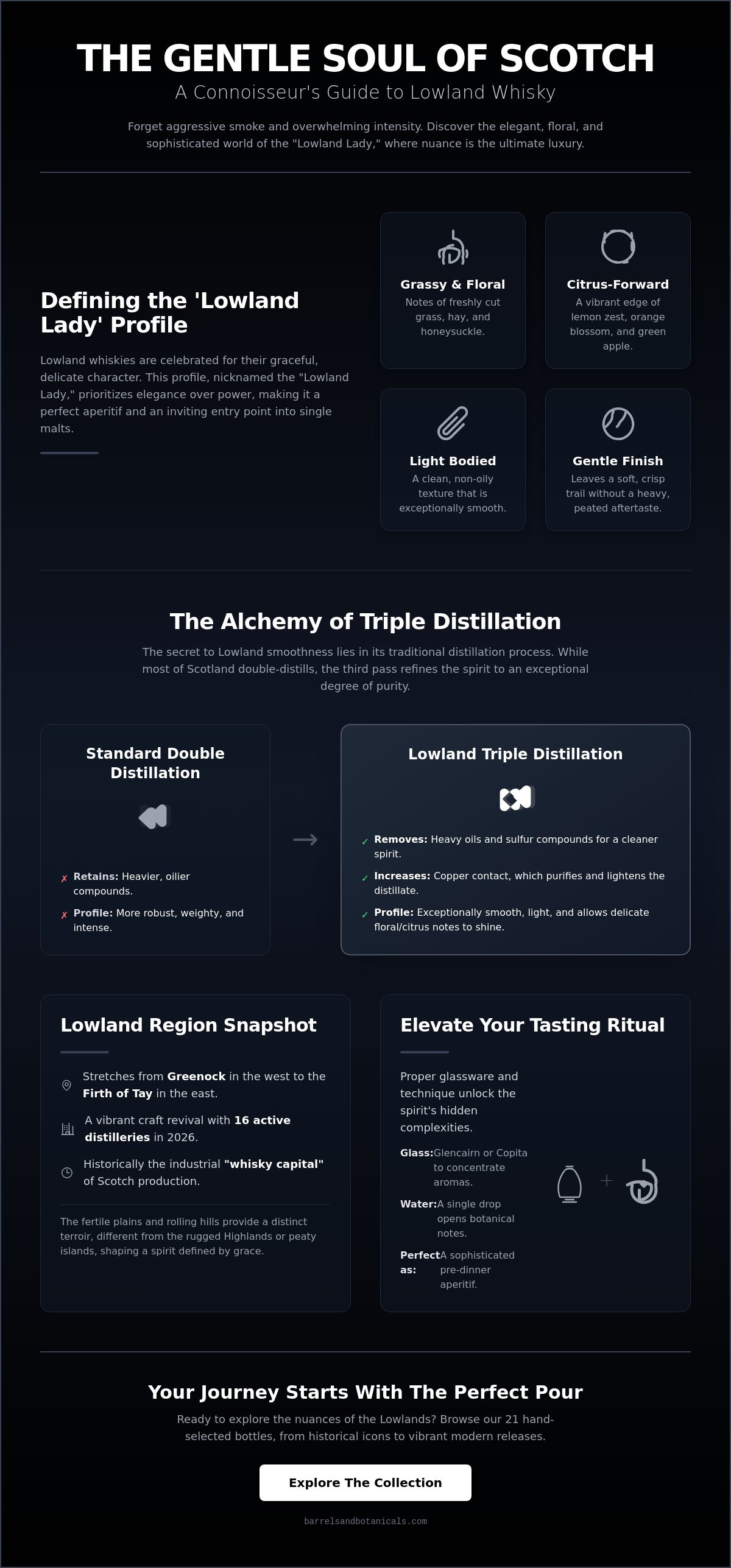
The Lowland region is defined by a legal boundary stretching from Greenock in the west to the Firth of Tay in the east. It's a landscape of rolling hills and fertile plains, far removed from the jagged peaks of the North. While the Highlands offer rugged intensity and Islay provides medicinal smoke, Lowland single malts prioritize grace. This is the home of the "Lowland Lady." This nickname isn't just a nod to geography; it's a sensory description of the spirit's character. Expect a profile that's unapologetically grassy, floral, and citrus-forward. The finish is gentle. It leaves a soft trail of lemon zest or honeysuckle rather than a heavy, oily residue. It's a style that rewards patience and a keen nose.
The History of the Lowland Distilling Tradition
The story of the South is one of dramatic peaks and quiet resilience. In the 19th century, this was the industrial heart of Scotch production. It was the "whisky capital" because of the sheer volume flowing from its stills. Much of this history is built on grain whisky, the vital backbone of the global blending industry. However, as tastes shifted, many legendary names fell silent. Distilleries like Rosebank became "lost" icons. Their remaining bottles are liquid gold, cherished for their delicate, floral complexity. Today, we're witnessing a vibrant craft revival. With 16 active distilleries in 2026, the region has transformed. It's no longer a quiet corner; it's a hotbed of artisanal innovation where new producers honor old traditions while embracing modern clarity.
Why Lowland Malts are the Perfect Aperitif
A great drink should prepare the palate, not overwhelm it. The light, vibrant nature of a lowland dram makes it the quintessential sophisticated aperitif. Because these malts typically lack heavy peat, the delicate botanical notes shine. Think of it as a liquid garden. Aromas of freshly cut grass, orange blossom, and light honey dance in the glass. This clarity makes them an exceptional base for a classic cocktails ritual. The spirit's floral essence enhances rather than competes with other ingredients. It's about mindful enjoyment. Savoring the crispness of a well-crafted malt before a meal is a tradition that values quality. It turns a simple drink into a curated sensory experience that awakens the appetite and heightens the senses for the meal to follow.
The Art of Triple Distillation: Why Lowland Whisky is So Smooth
Elegance isn't an accident. In the southern distilleries, it's a deliberate result of chemistry and copper. While most of Scotland relies on double distillation, the traditional lowland method often introduces a third stage. This isn't just about repetition. It's about refinement. Each pass through the still strips away heavier, oilier compounds. These are the molecules that give Highland malts their weight and Islay malts their grit. By removing them, distillers create a spirit that is exceptionally clean. It's a process of purification that allows the most delicate aromatics to emerge unscathed.
Copper is the silent hero here. During triple distillation, the spirit enjoys significantly more contact with the metal. This interaction acts as a filter. It removes sulfur and impurities, leaving behind a light, floral essence. While not every distillery in the Lowlands Scotch Whisky Region employs this method today, it remains a defining hallmark of the region's historical identity. It's the secret behind that silk-like texture. It's why these drams feel weightless on the tongue yet vibrant in the glass.
Nuance in the Still: Pot Stills vs. Column Stills
The architecture of the still dictates the soul of the whisky. Lowland pot stills are often taller, designed to encourage "reflux." This means only the lightest vapors reach the top to be condensed. Distillers meticulously select the "middle cut," or the heart of the run. This specific portion captures the brightest notes. Think lemon peel. Fresh hay. Green apple. This focus on the lighter end of the spectrum is what grants these whiskies their famous citrus edge. It's a precise, artisanal choice that prioritizes clarity over brawn.
Cask Influence on a Delicate Spirit
A delicate spirit requires a gentle touch in the warehouse. Because the lowland distillate is so nuanced, it can be easily overwhelmed by aggressive wood. Master blenders often favor second-fill casks or ex-bourbon barrels. These vessels impart soft layers of vanilla, cream, and toasted coconut without masking the spirit's floral character. It's a balance of power and poise. For those interested in how these aging rituals evolve, you might look for rare scotch online UK to find vintage expressions that have spent decades maturing in specific, high-quality oak. To truly appreciate this craftsmanship, explore our curated selection and discover how wood and spirit find their perfect harmony.
How to Choose Your Perfect Lowland Dram
Selecting the right bottle requires an honest assessment of your palate. Are you seeking the dew-drenched freshness of "cut grass" or the warming embrace of "cinnamon and ginger"? While the region is famous for its botanical clarity, the modern landscape offers a spectrum of intensity. A traditional lowland malt provides a bright, citrus-forward experience. However, recent cask innovations have introduced deeper, spicier profiles that challenge the "light" stereotype. Your choice should reflect the moment. A daily sipper might favor accessibility and crispness, while a celebratory investment demands the complexity of a long-matured cask finish.
Value in this region is found by looking beyond the numbers on the label. While a 12-year-old age statement offers a reliable benchmark of quality, don't overlook Non-Age Statement (NAS) releases. In the South, NAS often signifies a master blender's freedom to prioritize flavor over a specific date. These expressions frequently showcase the vibrant, youthful energy of the spirit. You must also weigh the "Old Guard" against the "New Wave." Heritage brands offer consistency and a link to the past. Modern startups, part of the 2026 renaissance, bring experimental barley varieties and unique yeast strains that are redefining what a southern malt can be.
Key Distilleries to Know in 2026
- Auchentoshan: The definitive master of triple distillation. It delivers a silk-like texture and an accessible profile that serves as the perfect entry point.
- Glenkinchie: Known as the "Edinburgh Malt." It's a liquid garden, celebrated for its light, floral aromatics and a classic, grassy finish.
- Bladnoch: A story of remarkable revival. Located in the deep south, it offers a bolder, more complex spice profile for those who want a dram with extra brawn.
Common Mistakes When Buying Lowland Whisky
The most frequent error is mistaking "light" for "weak." A lowland spirit is nuanced, not thin. Its botanical intensity is a deliberate craft, requiring a focused palate to appreciate the layers of lemon zest and honeysuckle. Another mistake is ignoring the ABV. Many of these malts benefit from a slightly higher proof, which carries the delicate floral oils more effectively. Finally, don't limit your search to the supermarket shelf. Many of the most exciting, small-batch releases are found through specialists. Always check the whisky shop Turriff for limited editions and exclusive bottlings that capture the true essence of the region's current craft revival.
Standout Bottles: Curated Highlights from Our Collection
Selection is an art form. At Barrels & Botanicals Ltd, we've curated a definitive range of 21 lowland expressions to guide you through this region's remarkable renaissance. This isn't a mere list. It's a sensory roadmap through rolling barley fields and copper-scented stillhouses. From the sharp bite of fresh ginger to the mellow sweetness of orchard grass and buttery toffee, every bottle tells a story of intentional craft. We invite you to slow down and explore the nuanced profiles that define the modern southern dram.
The Beginner's Choice: Accessible Elegance
For those new to the region, the Auchentoshan 12 Year Old remains the gold standard of accessible smoothness. Because it's triple distilled, the spirit is exceptionally pure. The nose is a revelation of toasted almonds and crème brûlée. On the palate, you'll find a vibrant burst of tangerine and lime. The finish is crisp, gingery, and lingering. It's an inviting gateway that offers premium quality at an excellent value, proving that sophistication doesn't have to be intimidating.
The Connoisseur's Choice: Rare and Complex
If you're seeking depth and historical weight, the Bladnoch 19 Year Old is a masterpiece of maturation. Aged in PX Sherry casks, it presents a deep mahogany hue that hints at its complexity. The nose offers notes of polished oak and liquorice. On the palate, you'll discover a velvet texture laden with dried apricots and toasted almonds. It's a long, warming experience for the serious collector. For those hunting for the truly extraordinary, our rare scotch guide provides further insight into these exceptional finds.
The Modern Maverick: New Distillery Profiles
The future of the region is being written by names like Lindores Abbey and Kingsbarns. These distilleries are the "future classics." By using local Fife barley and heritage yeast strains, they create spirits that feel both ancient and innovative. Kingsbarns, for instance, offers a lighter, floral profile that mimics a summer meadow. These bottles represent a shift toward transparency and terroir. They're vibrant. They're purposeful. They're essential for any modern bar. To find your next favorite bottle, shop our full whisky range and elevate your home ritual.
Every bottle in our Lowland Collection has been chosen for its ability to transform a simple pour into a curated moment of quality. Whether you prefer the honeyed sweetness of the old guard or the bold experimentation of the new wave, there's a dram waiting to be discovered.
The Ritual: Serving and Savouring Lowland Whisky
The beauty of a lowland dram lies in its subtlety. It's a spirit that doesn't shout; it whispers. To hear it, you must treat the serve as a deliberate ritual. This isn't a drink to be rushed. It's a curated experience that begins with the right environment and ends with a lingering, floral finish. Slowing down allows the nuanced layers of the spirit to reveal themselves. Cool glass. Clear spirit. A moment of pause. This is the essence of mindful drinking.
Choosing your vessel is the first step in this sensory journey. While a heavy tumbler feels substantial, it lacks the architecture to focus delicate aromatics. The Glencairn glass is a sturdy, reliable choice for traditional tasting. However, for the lighter profile of the South, many connoisseurs prefer the Copita. Its elegant, tulip-shaped bowl and narrow rim trap the volatile esters. It focuses the "nose" directly toward your senses. You'll catch the scent of lemon balm and meadowsweet far more clearly in a glass designed for precision.
Water remains a point of debate, but for these malts, a single drop is often a key. You aren't diluting the spirit; you're conducting a small piece of liquid alchemy. A drop of room-temperature water breaks the surface tension of the oil. It "opens up" the dram. Suddenly, a nose that felt closed might bloom with the scent of fresh hay or orange blossom. Experiment with a tiny pipette. Find the point where the alcohol's heat recedes and the botanicals take centre stage.
Culinary harmony adds another layer to the ritual. Because these whiskies are vibrant and light, they pair exquisitely with delicate flavours. Think of smoked salmon, fresh oysters, or creamy goat's cheese. These pairings don't compete with the spirit; they complement its citrus edge. For those who enjoy a broader sensory exploration, you'll find these profiles often mirror the herbal complexity found in Scottish gin. Both spirits celebrate the purity of their ingredients and the precision of their distillation.
Lowland Whisky in Cocktails
The light, floral profile of this region makes it a versatile tool for the home mixologist. It doesn't get lost; it elevates. In a Whisky Sour, the spirit's natural citrus notes harmonize perfectly with the lemon. For a refreshing afternoon serve, try a Highball with premium soda water and a twist of grapefruit. The carbonation lifts the delicate aromatics, creating a "Lowland Spritz" that's sophisticated and crisp. Our classic cocktails guide offers more recipes for those looking to transform their bottle into a masterpiece.
Where to Buy Authentic Lowland Whisky Online
Quality sourcing is the final part of the ritual. Buying from a family-run specialist ensures your bottle has been selected with expert knowledge and handled with care. We understand the heritage of the 16 active distilleries in the region. We offer secure UK-wide shipping and expert packaging, ensuring that even the rarest bottles arrive in pristine condition. Whether you're seeking a daily sipper or a collector's item, we act as your guide to the best of the South. Explore our full Lowland Whisky collection today and bring a touch of Scottish elegance to your home bar.
Begin Your Journey into Lowland Sophistication
The journey through the South is one of constant discovery. You've seen how the "Lowland Lady" has evolved from a quiet industrial giant into a vibrant, botanical-forward icon of modern craft. By embracing the ritual of the right glassware and a mindful approach to every pour, you unlock a world of citrus edges and honeyed depths. This isn't just about a drink. It's about a curated experience that values clarity and quality above all else. The 2026 renaissance has proven that elegance and complexity belong in the same glass.
As a family-run UK specialist, we take pride in our artisanal focus. Our expertly curated selection features over 21 lowland malts, ranging from accessible entry points to rare, vintage gems. We ensure these premium spirits reach you with care through our nationwide delivery service. Whether you're seeking a sophisticated aperitif or a complex addition to your collection, the perfect dram is waiting. High-quality spirits deserve a place in your home ritual.
Discover the Elegance of the Lowlands – Shop Our Collection
Step into a new era of drinking where every sip is a celebration of refined taste and intentional living. Your next favorite bottle is waiting.
Frequently Asked Questions
What is the difference between Lowland and Highland whisky?
Highland whiskies are defined by rugged terrain and often possess a weightier, spicier profile. In contrast, a lowland malt reflects the rolling hills of the South with a lighter, grassier essence. While Highland spirits can be robust and honeyed, this region prioritizes botanical clarity and a silk-like finish.
Is all Lowland whisky triple distilled?
Triple distillation is a regional hallmark but not a universal rule. Auchentoshan remains the most consistent practitioner of this traditional method today. Other distilleries in the region may use double distillation while still achieving signature elegance through tall stills and precise cuts that capture only the lightest vapours.
What are the best Lowland whiskies for beginners?
Auchentoshan 12 Year Old and Glenkinchie 12 Year Old are the quintessential starting points. These bottles offer a vibrant introduction with their honeyed sweetness and citrus-forward palates. They are approachable. Sophisticated. They serve as the perfect gateway for those new to the world of premium single malts.
Can I find peated Lowland whiskies?
Peated expressions are increasingly available as the region undergoes a modern renaissance. Distilleries like Ailsa Bay and Annandale are leading this shift, creating spirits that blend traditional floral notes with a refined, medicinal smoke. It is a bold, artisanal departure from the classic unpeated style.
Why is Lowland whisky often called 'The Lowland Lady'?
This moniker celebrates the region's characteristic elegance and delicate spirit. Much like a sophisticated host, a lowland whisky is welcoming and nuanced rather than aggressive. It is a poetic nod to the floral aromatics and the gentle, lingering finish that defines the regional identity.
What food pairs best with a Lowland single malt?
Light seafood and creamy cheeses are the natural partners for these malts. The spirit's citrus edge cuts through the richness of smoked salmon or a soft brie. For a celebratory ritual, try pairing a dram with a lemon tart to highlight the vibrant orchard fruit notes and botanical essence.
Are there any 'lost' Lowland distilleries I should look for?
Rosebank and Littlemill are the most legendary "lost" names to seek out. These bottles are rare treasures for the serious collector, prized for an ethereal complexity that is difficult to replicate. Finding an authentic bottling from these silent stills is a genuine moment of liquid history.
How should I store my Lowland whisky collection?
Store your bottles upright in a cool, dark environment to preserve their nuanced character. Unlike wine, the high alcohol content can degrade the cork if it stays in constant contact. Keep the temperature consistent and avoid direct sunlight. This ensures the delicate floral notes remain vibrant for years to come.