
The finest whisky in your collection is arguably the one you are most afraid to drink. Most enthusiasts settle for the standard 40% ABV bottling, yet they miss the vibrant, unedited soul of the spirit that exists only before the water is added. Perhaps you have stared at a £120 bottle, intimidated by the high alcohol volume or worried that a single drop of water might ruin the master blender's work. It's a common hesitation. You want the essence of the oak without the scorched palate. Having cask strength whisky explained allows you to move past the technical jargon and embrace the purest expression of the distillery's craft.
We believe every pour is a ceremony. In this guide, you'll learn to master the ritual of personal dilution and understand the science of maturation that occurs over decades in a Highland dunnage warehouse. From deciphering proof to confidently selecting rare bottles at auction, we provide the clarity you need. Prepare to transform a high-proof burn into a nuanced, sensory journey. Bold flavours. Intentional sips. This is your path to becoming a true connoisseur of the cask.
Key Takeaways
- Uncover the raw, unedited essence of spirits straight from the wood as we have cask strength whisky explained, contrasting these potent expressions with standard bottles cut to 40% ABV.
- Delve into the alchemy of maturation and the "Angel's Share," understanding how the living dance between oak and air creates a truly unique, high-proof vintage.
- Unlock a sensory revelation by exploring why non-chill filtration is essential for preserving the vibrant, nuanced oils that define a truly premium palate.
- Elevate your tasting experience through a curated ritual, mastering the precise glassware and nosing techniques required to appreciate such concentrated intensity.
- Identify the hallmarks of quality on a premium label to confidently curate a collection of rare expressions from the UK’s most prestigious independent bottlers.
The Essence of the Barrel: Defining Cask Strength Whisky
Imagine the cool, damp air of a Highland dunnage warehouse. The scent of toasted oak and evaporating spirit hangs heavy. This is where the journey of the connoisseur begins. To have cask strength whisky explained, one must look past the commercial standard and into the heart of the barrel. In 2026, the "straight from the wood" experience represents the pinnacle of purity. It is the liquid exactly as it existed within the charred staves, untouched by the dilution tanks of the bottling hall. No water. No compromise. Just the raw, unfiltered essence of maturation.
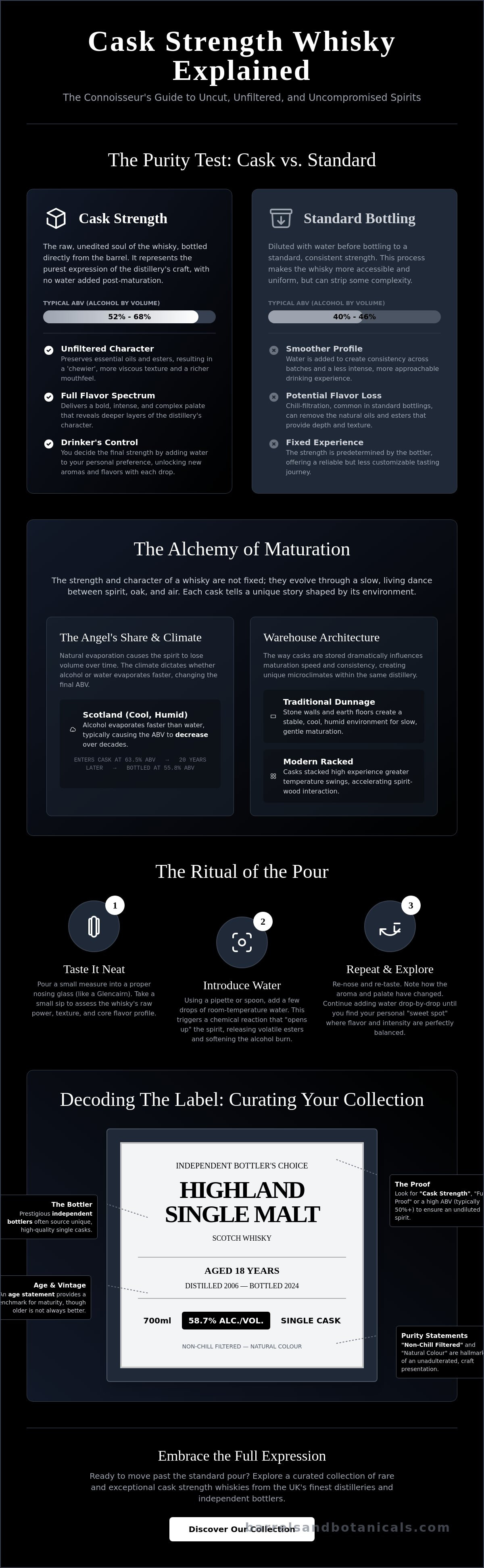
Standard whiskies are typically cut to 40% or 46% ABV. This creates a uniform profile and lowers the excise tax burden, as UK spirit duty is calculated based on pure alcohol volume. However, adding water at the bottling stage does more than just lower the proof. It alters the chemistry. Cask strength whisky preserves the essential oils and esters that give a dram its soul. These compounds provide the weight, the complexity, and the lingering finish. By removing the water, the distiller preserves a gain of intensity. Every sip reveals a deeper layer of the distillery's character. It is a vibrant, visceral encounter with the craft.
The ABV Spectrum: From 50% to the Mid-60s
The alcohol volume of a cask varies by climate and wood type. Most Scotch whiskies emerge from the barrel between 52% and 64% ABV. Bourbon often reaches higher peaks, sometimes hitting 68% due to the intense heat of Kentucky rickhouses. This alcohol volume dictates the initial sensory impact. It’s a heat that carries flavor. Still strength is often higher than the final cask strength because of the "angels' share," the natural evaporation that occurs over years. This loss is the price of excellence. High ABV creates a bold, punchy palate that demands a slow, mindful ritual.
Cask Strength vs. Bottle Strength: A Comparison
Bottle strength whiskies offer accessibility and consistency. They are designed for the casual evening. Cask strength is an artisanal choice for the adventurous epicurean. Because you’re buying more spirit and less water, the price point reflects this, with premium expressions often starting above £75. The real reward is the texture. Undiluted whisky feels "chewier" and more viscous on the tongue. It coats the palate in a way that diluted spirits cannot. Modern labels often distinguish between "Full Proof" and "Cask Strength." While "Cask Strength" is the proof at the moment of bottling, "Full Proof" usually refers to bottling at the same strength the spirit originally entered the wood.
- Cask Strength: The natural proof after maturation.
- Bottle Strength: Diluted to a standard (40-46%).
- Texture: Thick, oily, and persistent.
- Control: You decide how much water to add.
The Alchemy of Maturation: Why Strength Varies in the Cask
Inside the charred oak staves, a silent, rhythmic conversation begins. The spirit breathes. It pulls from the wood, then pushes back, absorbing vanillins, tannins, and lignins. This isn't a static storage process; it's a slow dance with the surrounding air. The oak is porous, allowing the whisky to interact with the damp Scottish climate or the dry heat of a Kentucky summer. Every year, the liquid evolves. It softens. It deepens. Understanding the cask strength whisky explained in this context requires looking at the barrel as a living vessel rather than a simple container.
Warehouse architecture plays a vital role in this evolution. Traditional dunnage warehouses, with their thick stone walls and earth floors, keep temperatures remarkably stable. In these cool, humid spaces, the spirit matures slowly. Conversely, modern racked storage systems stack barrels high, exposing those near the roof to greater temperature fluctuations. A 5-degree Celsius difference between the floor and the ceiling can drastically alter how the spirit interacts with the wood. These environmental factors dictate the final character, making each barrel a unique record of its specific location.
The Angel's Share and Climate Dynamics
The "Angel's Share" is the poetic name for the natural evaporation that occurs during aging. In the UK's temperate, humid climate, alcohol tends to evaporate faster than water. This typically causes the ABV to drop over several decades. A spirit that enters the wood at 63.5% might emerge twenty years later at a mellow 46% or 52%. Understanding these nuances helps when deciding what to look for in a bottle of Scotch, as the label's ABV tells the story of its long rest. Through the slow escape of volatile molecules, the remaining liquid transforms into a more concentrated, textured essence of the original distillate.
Single Cask vs. Batch Strength
Collectors in 2026 increasingly prize the "fingerprint" quality of single cask expressions. These bottles represent a snapshot of one specific barrel's journey, untouched and unblended. They offer the rawest form of cask strength whisky explained through a single sensory lens. No two barrels are identical, even if they were filled on the same day from the same still.
- Single Cask: A solitary masterpiece, offering a unique ABV and flavour profile that can never be replicated.
- Batch Strength: A curated marriage of several high-ABV casks, blended to achieve a consistent house style while retaining a powerful, undiluted proof.
- Natural Variance: The reason why one bottle might be 58.2% while the next release is 57.9%.
For the modern enthusiast, the appeal lies in the lack of intervention. There's a certain honesty in a spirit that hasn't been diluted to a standard 40%. It allows for a more personal ritual of the pour, where you decide exactly how much water, if any, is needed to unlock the hidden botanicals and esters within the glass.
A Sensory Revelation: Why Connoisseurs Seek Undiluted Spirits
To have cask strength whisky explained is to understand the difference between a charcoal sketch and a vibrant oil painting. It's an invitation to experience the spirit exactly as the master blender does in the quiet of a dunnage warehouse. Most commercial whiskies in the UK are diluted to 40% or 43% ABV to meet tax regulations and consumer expectations. By contrast, Cask strength expressions remain untouched, typically arriving at your glass between 55% and 65% ABV. This isn't about the heat of the alcohol; it's about the preservation of the spirit's soul.
The aromatic intensity of an undiluted pour is staggering. The "nose" becomes a dense thicket of sensory data. You'll find concentrated notes of toasted manuka honey, damp earth, or singed orange peel that would otherwise be thinned out by industrial hydration. It's a celebratory ritual for the mindful epicurean. It requires the right glassware, a quiet moment, and a willingness to explore the liquid's evolution. Every sip is a curated choice for quality over quantity.
The Texture of Oils and Esters
High alcohol content acts as a superior solvent. It holds delicate flavor compounds and essential oils in suspension far more effectively than diluted spirits. This creates a physical sensation on the tongue. Velvet. Silk. A heavy, coating richness that lingers long after the swallow. Standard dilution often forces a distillery to use chill-filtration, a process that cools the liquid to 0°C to remove "impurities." In reality, this removes the very esters that provide character. Cask strength whiskies are almost universally non-chill filtered. They retain 100% of their natural fatty acids, ensuring the botanical nuances remain vibrant and intact.
The Myth of 'Too Strong'
There's a common misconception that a high ABV equates to a harsh or "burning" experience. This ignores the alchemy of time. When a spirit matures in oak for 12, 18, or 25 years, the wood mellows the ethanol's bite while concentrating the underlying sugars. The result is a glowing warmth rather than a sharp sting. When you choose cask strength whisky explained through the lens of craft, you gain ultimate control. You're the one who decides if the dram needs a single teardrop of water to "open up" the bouquet. You aren't settling for the distillery's version of balance; you're creating your own. It's an empowering way to drink that values clarity and personal preference.
The Ritual of the Pour: How to Drink Cask Strength Whisky
To have cask strength whisky explained is to understand that the experience begins long before the liquid touches your lips. It's a slow, deliberate choreography of the senses. Start with the vessel. Select a Glencairn glass or a traditional copita. These shapes aren't merely for aesthetics; they're precision tools designed to funnel heavy esters and volatile aromatics directly to your nose. The narrow rim concentrates the essence, allowing you to explore the spirit's architecture without the distraction of ambient air.
Your first encounter requires patience. High-proof spirits carry a potent, volatile heat that can easily overwhelm the unprepared. Approach the rim with caution. Keep your lips slightly parted as you inhale. This simple technique allows air to circulate, preventing the high alcohol content from numbing your olfactory receptors. You aren't just smelling whisky; you're unearthing layers of charred oak, sun-ripened stone fruit, and distant peat smoke. It's a sensory map of the barrel's history.
The first sip must be microscopic. A single drop on the tongue serves as a formal introduction. Let your palate acclimate to the intensity. This initial heat is a gateway, not a barrier. Once the palate settles, the second sip reveals the hidden textures of the spirit. The transition from high-proof intensity to a nuanced, layered experience is the hallmark of a masterfully distilled dram. It's a journey from fire to finesse.
The Art of Mindful Dilution
Precision is paramount when managing high ABV. Use a glass pipette to add room-temperature water drop by drop. This ritual isn't about weakening the spirit; it's about liberation. Water breaks the surface tension of the whisky, triggering a "blooming" effect. This chemical reaction releases volatile aromatic compounds that were previously trapped by the alcohol molecules. Watch for the viscous, oily swirls known as scotch mist. You're searching for your personal sweet spot, that precise moment where the vibrant botanical notes and deep spices outshine the alcoholic heat.
Essential Glassware and Environment
Temperature dictates the narrative of the pour. Avoid ice at all costs. Chilling the liquid dulls the delicate oils and suppresses the very flavors that define a premium cask expression. Seek natural light and a quiet setting to truly appreciate the spirit's clarity and viscosity. This environment elevates the pour from a simple drink to a meditative practice. Whether you're preparing classic cocktails with a robust base or enjoying a neat dram, the setting must match the quality of the liquid. A quiet room allows the finish to linger, turning a single glass into an hour of discovery.
Explore our curated collection of premium spirits and artisanal barware to perfect your home tasting ritual.
Curating Your Collection: Selecting Rare Cask Strength Expressions
Selecting a bottle for a serious collection requires an eye for the minute details. You aren't just looking for a brand; you're looking for a moment captured in wood. Look for "Natural Colour" and "Non-Chill Filtered" on the label. These phrases signal an unadulterated spirit. A high ABV, often sitting between 52% and 64%, suggests a liquid that hasn't been tampered with or diluted. Having cask strength whisky explained through the lens of a master blender helps you appreciate why these bottles are the pinnacle of any shelf. They represent the spirit in its most honest form.
Independent bottlers offer a distinct allure in this market. They celebrate the quirk of a single barrel, embracing the nuance that official distillery releases might blend away. Your collection should tell a story of time and wood. Balance is essential. Pair a vibrant, peat-forward eight-year-old expression with the deep, rancio notes of a thirty-year-old vintage. One offers energy; the other, wisdom. To find these exclusive barrels, many collectors now use buy rare scotch online UK services to access stock that bypasses traditional retail channels. This digital access brings the dunnage warehouse directly to your door.
The Investment Potential of Single Casks
Cask strength whiskies are finite assets. A single hogshead might only yield 250 bottles. When the last cork is pulled, that specific flavor profile vanishes from the world forever. This scarcity makes them highly sought after on the secondary market. Investors value the "outturn" number, which is the specific bottle count from a single cask. If you've spent years curating and now wish to liquidate your assets, a professional sell my whisky collection Scotland service ensures your high-proof assets reach the right buyers at peak valuation. Scarcity drives value, but quality sustains it.
Navigating the 2026 Rare Whisky Market
The 2026 market prioritizes provenance and the "nature intended" philosophy. Collectors want to know the warehouse conditions and the exact journey of the cask. Newer distilleries are gaining ground by releasing bold, high-ABV expressions that honor traditional methods. This transparency is the new gold standard for the modern epicurean. Whether you visit a physical whisky shop Turriff or use a digital equivalent, the goal remains the same. Seek the essence of the spirit. Honor the ritual of the pour. Having cask strength whisky explained as a curated choice for quality transforms the act of drinking into a mindful experience of pure craft.
Elevating Your Private Collection
Embracing the raw power of a spirit straight from the wood is the ultimate mark of a discerning palate. Having had cask strength whisky explained, you now understand that these expressions represent the pinnacle of distillery character. They offer a sensory journey through vibrant botanicals and deep oak influences that haven't been muted by dilution. Whether you're mastering the ritual of the drop or seeking a bottle that captures a specific moment in maturation, the depth found in these undiluted malts is unparalleled. Bold textures. Nuanced aromas. Pure essence.
Since 2019, Barrels and Botanicals has operated as a family-run specialist dedicated to the world's most exceptional liquids. We focus on old and rare single malts that tell a story of time and craftsmanship. Our private bottle sale and brokerage service ensures that every acquisition is as refined as the spirit itself. We invite you to move beyond the ordinary and discover a world where every sip is a curated choice for quality. The journey to a more sophisticated cabinet starts with a single, intentional selection. It's time to savour the craft as it was meant to be experienced.
Explore our curated collection of rare cask strength whiskies and begin your journey into the purest expression of the craft. Your next discovery awaits.
Frequently Asked Questions about Cask Strength Whisky
What is the difference between cask strength and barrel proof?
The distinction is primarily geographical; they refer to the same unfiltered process. Cask strength is the traditional British term used across Scotland and Ireland, while barrel proof is the American equivalent found on Bourbon labels. Both indicate the spirit was bottled directly from the wood without the addition of water to lower the alcohol volume. It's the purest form of the distiller's art.
Is cask strength whisky always better than regular whisky?
Quality is subjective, but cask strength offers a more concentrated sensory experience. Standard whiskies are often diluted to 40% or 43% ABV to ensure a uniform profile. When cask strength whisky explained through the lens of a connoisseur, it represents the raw, unadulterated soul of the distillery. You receive the full intensity of the oils and esters that dilution often masks.
Should I always add water to a cask strength whisky?
Adding water is a personal ritual rather than a requirement. A few drops of filtered water can lower the surface tension, releasing volatile aromatics that were trapped by high alcohol levels. This process allows you to discover nuanced notes of stone fruit or delicate spice. Experiment with small increments. Your palate should dictate the final proof of your glass.
Why is cask strength whisky more expensive?
Higher costs stem from UK tax regulations and lower yields per barrel. HMRC charges excise duty based on the pure alcohol content; a 60% ABV bottle carries significantly more tax than a standard 40% ABV expression. Because the liquid isn't stretched with water, a single cask yields roughly 30% fewer bottles. You're paying for the undiluted essence and the artisan's refusal to compromise.
Can you drink cask strength whisky neat?
You can certainly enjoy it neat if you prefer a bold, high-impact experience. Many enthusiasts appreciate the initial heat and the way it coats the tongue with rich, oily textures. Take tiny sips. Let the liquid linger. The intensity of a 58% ABV spirit requires patience to fully appreciate the complex layers of oak and grain without overwhelming your senses.
What does 'natural cask strength' mean on a label?
This term signifies the whisky is exactly as it was inside the wood. It guarantees no water was added to adjust the strength and no chill-filtration occurred to remove natural fats or oils. It also implies the absence of E150a caramel colouring. It's a hallmark of transparency. You're tasting a specific moment in time, captured directly from the warehouse floor.
How long does a bottle of cask strength whisky last once opened?
An opened bottle remains at its peak for approximately 12 to 24 months. Once the liquid level drops below half, the increased oxygen in the bottle begins to dull the more delicate botanical notes. Store your bottle upright in a cool, dark place to preserve the vibrancy. For the best experience, finish the final third within 180 days of reaching that level.
Does cask strength whisky get stronger as it ages?
In the United Kingdom, ABV typically decreases during maturation. Scotland's humid climate causes alcohol to evaporate faster than water, a phenomenon known as the Angels' Share. This usually results in a loss of 0.5% to 1.5% ABV per year. In contrast, whiskies aged in arid climates like Kentucky can actually increase in strength as water evaporates more rapidly than the spirit itself.