
What if the most profound statement in your collection is the one that whispers? For many, the journey into Scotch begins with the roar of Islay peat, yet a growing number of epicureans are finding their way back to the light. You may have felt overwhelmed by smoke-heavy drams or felt a lingering uncertainty regarding the "Lowland Lady" reputation, perhaps mistaking elegance for a lack of character. It's a common crossroad in a connoisseur's evolution.
This lowland single malt guide is designed to replace that hesitation with sensory mastery. We invite you to discover the nuanced, floral sophistication of Scotland’s most understated region and learn how to master its delicate ritual. Across the following pages, we'll navigate the 2026 landscape of over 20 operational distilleries, from the historic revival of iconic "ghosts" to the artisanal craft of the new wave. Prepare to transition from the power of peat to the gain of botanical clarity. Every drop is a masterclass in restraint.
Key Takeaways
- Uncover the history of the "Lowland Ladies" and the geographic boundaries that foster such restrained, sophisticated spirits.
- Learn to decode a vibrant sensory profile characterized by wildflower honey, lemon zest, and the essence of soft malt.
- Navigate the nuanced evolution from traditional icons to the modern "new wave" using this definitive lowland single malt guide.
- Gain the confidence to identify rare "ghost" bottlings from legendary sites like Rosebank and Littlemill for your collection.
- Master the sensory ritual of the mindful pour, ensuring every drop is savored in the proper artisanal glassware.
What is Lowland Single Malt? Defining the 'Lowland Ladies'
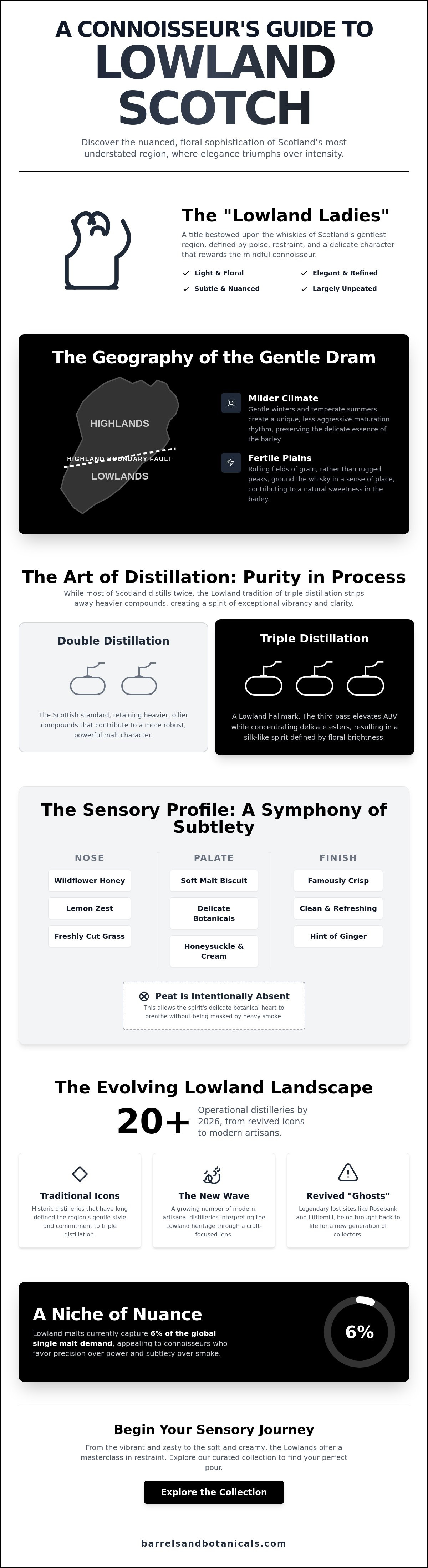
Poise. Restraint. A whisper that commands the room. These are the hallmarks of the "Lowland Ladies," a title bestowed upon the whiskies of Scotland's gentlest region. While the rugged North often favors peat and power, the South celebrates the botanical and the bright. This lowland single malt guide invites you to look past the misconception that "light" equals "simple." In the glass, these spirits offer a gain in clarity and a masterclass in subtle complexity. It's a choice for the epicurean who seeks depth without the distraction of heavy smoke.
The identity of these malts is rooted in the soil. Geographically, the region is defined by the Highland Boundary Fault, an ancient geological divide stretching from the Firth of Clyde in the west to the Firth of Tay in the east. Historically, this line served as a regulatory border; today, Lowland single malts represent a distinct sensory philosophy. They are the product of a landscape that swaps jagged peaks for fertile plains and rolling hills. By May 2026, the region has expanded to include over 20 operational distilleries, each interpreting this heritage through a modern, artisanal lens.
The Geography of the Gentle Dram
The Lowlands enjoy a milder climate than their northern neighbors. Gentle winters and temperate summers dictate a unique maturation rhythm. In the warehouse, the spirit breathes with the seasons without the aggressive wood extraction found in harsher climates. This patience preserves the essence of the barley. Rolling fields of grain and soft coastal breezes influence the profile, grounding the whisky in a sense of place. The Highland Boundary Fault isn't just a line on a map. It's the threshold where the roar of the Highlands softens into a melodic hum.
Triple Distillation vs. Double Distillation
Purity is a ritual here. While most of Scotland distills twice, several Lowland icons adhere to the tradition of triple distillation. This third pass through the copper stills strips away the heavier, oilier compounds that characterize more robust malts. The process demands meticulous control and a master blender's intuition to ensure the heart of the spirit remains intact.
The result is a spirit of exceptional vibrancy. It's a liquid that feels like silk on the palate. Triple distillation elevates the spirit's ABV while concentrating delicate esters, resulting in a profile defined by floral brightness rather than heavy oils. You'll find notes of lemon zest, cut grass, and wildflower honey. It's a clean canvas. It's an invitation to notice the smallest details. This commitment to clarity has become the region's greatest strength, attracting a new wave of drinkers who value precision over punch.
The Sensory Profile: Botanicals, Citrus, and Grass
Close your eyes. Breathe. The first encounter with a bottle from this lowland single malt guide isn't an assault; it's a sophisticated greeting. The nose offers an immediate gain in brightness. Freshly cut grass. Lemon zest. Wildflower honey. These aren't just scents; they're the vibrant essence of a Scottish meadow in spring. It's a sensory ritual that rewards the patient observer with layers of clarity. Every sniff reveals a new botanical secret, from the zest of a sun-ripened citrus fruit to the delicate sweetness of clover.
The palate continues this narrative of elegance, moving away from the heavy, oily textures of the North. You'll find soft malt biscuit notes underpinning a structure of delicate botanicals. The finish is famously crisp. It's a clean exit that leaves the palate refreshed, making these spirits the ultimate aperitif for the mindful drinker. Exploring the Lowland Distilleries reveals a consistent commitment to this ethereal style. It's a profile that currently captures 6% of the global single malt demand, appealing to those who favor precision over brute force.
The Botanical Essence of the Lowlands
The local terroir speaks through the grain. Fertile soils south of the Highland Line produce a natural sweetness in the barley, often manifesting as honeysuckle or rich cream. As the spirit ages in the temperate Lowland climate, you'll detect hints of ginger and toasted oak. Identifying "green" notes is a key part of the blind tasting ritual. Look for the stemmy, herbal quality of young fern or freshly snapped pea pods. These nuances are the heroes of the story. To begin your own sensory journey, you can explore our curated collection of artisanal single malts and craft spirits.
Nuance Over Power
Peat is largely absent here. This omission is intentional. It allows the spirit's botanical heart to breathe without being masked by heavy smoke. Much like a crisp white wine or a premium craft gin, the appeal lies in the layers of subtle flavor that emerge only when the palate isn't overwhelmed. A classic 12-year-old Lowland malt glides across the tongue with a weightless, silken texture that feels more like a sun-warmed breeze than a heavy spirit. It's a sophisticated choice for those who value the intricate details of a master blender's craft. Vibrant. Nuanced. Pure. This is the gain of the Lowland style.
Distillery Deep-Dive: Traditional Icons and the New Wave
The landscape of the South has shifted. For decades, the region was sustained by a resilient trio of producers, but May 2026 tells a different story of growth and artisanal pride. This lowland single malt guide highlights a category that has expanded from a handful of survivors to over 20 operational distilleries. It's a renaissance of flavor. Urban distilleries now sit alongside farm-based operations, each contributing to a collective gain in regional diversity. Whether you seek the historical weight of a legacy brand or the experimental edge of a newcomer, the Lowlands offer a curated experience for every palate.
Understanding the "Lowland lowdown" requires looking at both the pillars of the past and the pioneers of the future. As noted in Cigar Aficionado's guide to Lowland Scotch, the region is defined by a soft, floral, and grassy character that makes it an ideal companion for a refined lifestyle. This section explores the specific houses where these elegant spirits are born.
The Established Guardians
Auchentoshan remains the definitive practitioner of the triple-distillation ritual. Located near Glasgow, it bridges urban grit with a silken spirit. It's exceptionally smooth. Citrus-forward. Approachable yet layered. In contrast, Glenkinchie serves as the "Edinburgh Malt," nestled in a garden-like setting in East Lothian. Its character is distinctly floral and dry, playing a vital role in high-end blends while standing tall as a sophisticated single malt. For those who enjoy a modern twist, Ailsa Bay uses data-driven science to balance precise smoke levels with a characteristic Lowland sweetness, proving that innovation has a home in the South.
The Artisanal Renaissance
The "new wave" is led by distilleries that treat whisky as a sacred craft. Lindores Abbey in Fife returned production to its spiritual home in 2017, honoring a legacy that dates back to 1494. Their spirit is vibrant and fruit-driven. Daftmill, a seasonal farm distillery, produces limited runs that have become a collector's obsession. It's true farm-to-bottle excellence. Fresh. Seasonal. Rare.
Coastal influences are also emerging as a new regional marker. Kingsbarns, located on the Fife coast, utilizes local barley to create a spirit that feels sun-drenched and maritime. Meanwhile, the Clydeside Distillery has brought production back to the heart of Glasgow's docks, focusing on a light, tropical profile. These newcomers don't just mimic the past; they refine it. They offer a gain in transparency and terroir that defines the modern era of Scottish spirits. The Lowland identity is no longer just about being "light." It's about being intentional.
The Rare and the Lost: Investing in 'Ghost' Distilleries
There is a unique thrill in the pursuit of the finite. In the world of fine spirits, "ghost" distilleries represent the pinnacle of this chase. These are sites where the stills have long fallen silent, yet their liquid legacy continues to mature in secret. For the collector, this isn't about loss. It's about the acquisition of a liquid time capsule. This lowland single malt guide explores why names like St. Magdalene and Port Dundas are commanding record prices at auction in 2026. These bottles offer a nuanced gain in complexity that simply cannot be replicated by modern production. They are rare. They are irreplaceable. They are the essence of a bygone era.
The Legend of Rosebank
Rosebank is often called the "King of the Lowlands." For three decades, it existed only as a memory after closing in 1993. That changed on June 7, 2024, when the distillery officially reopened its doors to the public. While new spirit began flowing on July 18, 2023, the focus for serious connoisseurs remains on the pre-closure stock. The Rosebank Vintage 1989, a 33-year-old expression priced at £3,200, stands as a testament to the distillery's floral, triple-distilled elegance. When seeking these bottles, look for the signature citrus and cream profile that defined the "Rosebank style" before the gates closed. It's a profile that has welcomed over 33,000 visitors since the reopening, proving the enduring allure of this Lowland icon.
Selling and Brokering Rare Lowland Malts
The market for closed-distillery malts has never been more vibrant. As of May 2026, demand for Lowland "ghost" whiskies has outpaced many Highland counterparts, driven by a global appreciation for the region's sophisticated profile. If you are considering selling your whisky collection in Scotland, provenance is your most valuable asset. Buyers require meticulous documentation of storage and origin. Fortunately, the process of holding these assets became simpler on March 3, 2025, when HMRC amended regulations, removing the requirement for owners to register personally to store whisky in excise warehouses. This change has streamlined private collections significantly.
For those looking to expand their cellar, knowing how to buy rare scotch online UK is essential for navigating the secondary market with confidence. Private brokerage fees for rare Lowland editions typically range from 10% to 15%, reflecting the expertise required to verify and facilitate these high-value transfers. Whether you are acquiring a bottle of Littlemill, the oldest and most tragic of the lost distilleries, or a rare grain from Port Dundas, the ritual remains the same. Research. Verify. Savor. To discover your next investment piece, view our exclusive selection of rare spirits and begin your journey into the extraordinary.
The Ritual: How to Savor a Lowland Single Malt
True elegance demands an audience that is willing to wait. The final step in this lowland single malt guide is the ritual itself. It's the intentional act of slowing down to appreciate the mastery in the glass. This isn't a dram for a hurried evening. It's a curated choice for quality. By May 2026, the global shift toward mindful drinking has moved the focus from quantity to the sensory gain of a single, perfect experience. The ritual begins with the pour and ends with a lingering, vibrant finish that stays with you long after the glass is empty.
The Glassware and the Pour
Heavy tumblers are the enemies of elegance. Their wide rims allow delicate esters to escape too quickly, masking the very botanicals you seek to discover. Instead, choose a Glencairn or a tulip-shaped glass. These vessels concentrate the "nose," funneling scents of lemon zest and meadowsweet directly to the senses. Temperature is equally vital. Avoid the chill of ice. Cold temperatures suppress the volatile compounds that give Lowland malts their signature clarity. Serve your spirit at a room temperature of 18 to 20 degrees Celsius. Once poured, allow the liquid to rest for exactly 10 minutes. This patience allows the spirit to breathe and the aromas to harmonize.
The "Mindful Pour" is a visual feast. Tilt the glass. Observe the "legs" as they crawl slowly down the crystal, indicating the spirit's texture and natural oils. When it comes to water, restraint is your guide. A single drop of room-temperature spring water is often all that's required to "open up" the bouquet. It breaks the surface tension, releasing a hidden essence of toasted oak and ginger that might otherwise remain locked away.
Pairing the Lowland Palette
Pairing is an art of balance. The light, grassy profile of a Lowland malt finds its perfect companion in the delicate brine of smoked salmon or the sharp, creamy tang of a local goat's cheese. For a sweeter finish, a lemon tart or a floral-infused dessert mirrors the citrus notes of the spirit. If you wish to extend the ritual, consider a pairing with a lighter "New World" cigar. The cedar and mild spice of a premium Nicaraguan or Dominican leaf complement the whisky without overwhelming its nuanced character.
Create your environment with intention. Soft music. Dim lights. Exceptional company. The absence of heavy smoke in the whisky allows for a clearer connection to your surroundings and your palate. It's a celebration of the present moment. To ensure your home bar is equipped for this elevated experience, you can explore our artisanal spirits and premium cigars to find your next favorite pairing. This is the ultimate gain of the Lowland experience. Vibrant. Nuanced. Entirely yours.
Master the Art of the Lowland Sip
The South has reclaimed its voice. From the botanical heart of the "Lowland Ladies" to the high-stakes return of legendary names, the region offers a gain in clarity that the modern epicurean can't ignore. You now possess the tools to navigate this lowland single malt guide with confidence. You've learned to identify the silken mouthfeel of a triple-distilled dram and how to secure a rare "ghost" investment for your cellar. It's a world where precision meets passion. Every bottle tells a story of terroir and time.
At Barrels & Botanicals Ltd, we celebrate this intentional way of living. Our family-run team has shared its expertise since 2019, acting as specialists in old and rare whisky brokerage and offering a curated selection of artisanal, small-batch spirits. We invite you to Explore our curated collection of Lowland Single Malts and find the expression that speaks to your own sensory ritual. The next chapter of your collection starts with a single, elegant drop. Savor the gain.
Frequently Asked Questions
Is Lowland whisky always triple distilled?
No, triple distillation is a traditional signature but not a universal requirement for the region. While icons like Auchentoshan maintain this three-stage ritual for maximum purity, many others utilize the standard double distillation process. This lowland single malt guide highlights that the regional identity is defined more by its elegant, botanical flavor profile than by a single production method. It's about the result in the glass.
Why is Lowland whisky often called the 'Lowland Lady'?
The "Lowland Lady" moniker refers to the region's historical reputation for producing whiskies with grace, lightness, and a distinct lack of aggression. Unlike the robust, peat-driven spirits of the North, these malts favor floral notes and a silken texture. It's a celebratory title for a spirit that values nuance over power. This elegance makes them the perfect choice for a mindful, sophisticated sensory experience.
What is the best Lowland whisky for a beginner?
Auchentoshan 12-Year-Old is widely considered the most accessible entry point for those new to the region. Its triple-distilled smoothness removes any harsh edges, offering a palate of toasted almonds and lime. Glenkinchie 12 is another excellent choice, providing a light, grassy introduction to the "Edinburgh Malt" style. Both options allow a beginner to appreciate the gain of subtle flavors without being overwhelmed by smoke.
Are there any smoky or peated Lowland whiskies?
Yes, several modern distilleries are breaking tradition by releasing peated expressions. Glasgow 1770 produces a dedicated Peated range, while InchDairnie experiments with various smoke profiles. These releases represent the "new wave" of the Lowlands, where innovation meets heritage. They offer a sophisticated take on smoke that remains balanced by the region's characteristic floral and citrus heart.
Which Lowland distilleries are currently closed or 'ghost' distilleries?
Littlemill, St. Magdalene, and Port Dundas remain the most prominent "ghost" distilleries whose stocks are finite and highly valued. While Rosebank was the most famous closed site for 30 years, it officially reopened for visitors on June 7, 2024. Collecting these rare bottles requires a focus on provenance, as the spirit from truly lost sites can never be replaced once the final cask is bottled.
How should I store my rare Lowland single malt?
You must store your rare bottles upright in a cool, dark environment with a consistent temperature. Unlike wine, the high ABV of whisky will degrade a cork if left in contact for long periods. Keeping your collection away from direct sunlight preserves the vibrant color and delicate esters. This simple ritual ensures your investment retains its value and sensory integrity for decades.
What is the difference between Lowland and Speyside whisky?
Lowland whiskies are generally characterized by "green" notes like cut grass and honeysuckle, whereas Speyside malts often feature heavier fruit and honey profiles. While Speyside is known for its classic Scotch sweetness, the Lowlands offer a more botanical and citrus-forward experience. The difference is one of weight and intent. Speyside provides a rich embrace; the Lowlands offer a refined, airy elegance.
Can I visit the new distilleries in the Lowlands in 2026?
Yes, you can visit over 20 operational distilleries across the region as of May 2026. Rosebank has welcomed over 33,000 visitors since its 2024 reopening, and newer sites like Ardgowan, completed in 2025, offer state-of-the-art tour experiences. The region has transformed into a vibrant hub for whisky tourism, allowing enthusiasts to witness the artisanal renaissance of the South firsthand.