
What if the most prestigious number on the back bar is actually the one masking the true soul of the spirit? We’ve all felt that pull toward the bottle with the storied, double-digit age statement, believing that time alone crafts perfection. It’s a natural instinct. You seek the depth, the history, and the prestige that comes with decades of quiet maturation. Yet, one must ask: is older whisky always better, or are we sometimes simply paying for the evaporation of the angels' share?
You deserve to know why the number on the label is only half the story. This guide provides a framework to identify truly exceptional Single Malt Scotch regardless of its vintage. With the U.S. lifting tariffs on UK whisky as of April 30, 2026, the selection available to the modern epicurean has never been more vibrant. We will explore the concept of peak maturation. It is a fleeting, sensory harmony where spirit and oak achieve a brilliance that no calendar can guarantee. You'll learn to evaluate non-age statement releases with clarity and choose your next dram based on the abundance of flavor rather than the weight of years. Let's find your peak.
Key Takeaways
- Master the legal nuances of the age statement. Realize that the youngest drop dictates the label, ensuring you understand the true maturity of every pour.
- Explore the science of peak maturation to decide if is older whisky always better for your palate, or if younger, vibrant spirits offer the complexity you crave.
- Recognize the "dullness factor" where excessive oak tannins mask distillery character. Preservation of the original spirit is the mark of a master blender.
- Develop a professional sensory ritual. Focus on the finish and the elegant harmony between wood and grain to identify excellence beyond the brand name.
- Build a sophisticated collection. Learn to value the bold energy of artisanal small-batch releases alongside the quiet, concentrated history of rare older vintages.
Beyond the Number: Deconstructing the Allure of the Age Statement
There is a distinct ceremony in uncorking a vintage bottle. The heavy glass; the sigh of the cork; the amber liquid that has waited decades for this exact moment. For many enthusiasts, the bold numerals on the label serve as a definitive compass for quality. Yet, the central question of the modern connoisseur persists: is older whisky always better, or have we been enchanted by the romance of the clock?
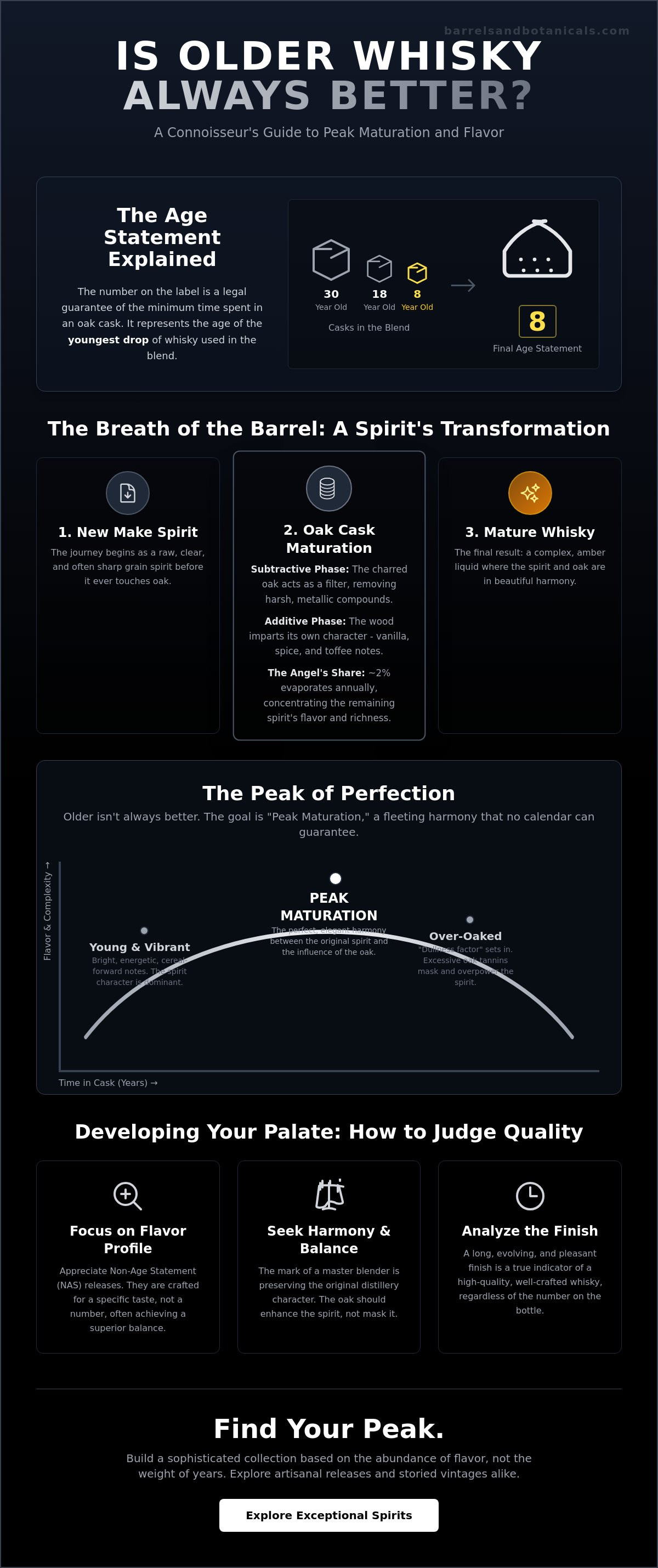
To understand this landscape, one must first recognize the rigid architecture of the label. An age statement is a legal minimum of maturation in oak casks. This means the number you see represents the youngest drop of spirit within the bottle. If a master blender marries a thirty-year-old cask with a splash of an eight-year-old spirit, the bottle must legally bear the number eight. This transparency is the bedrock of Scotch whisky's integrity. It ensures that the consumer knows exactly the minimum level of patience invested in the liquid. Historically, the industry leaned on benchmarks like 12, 15, and 18 years to signal premium tiers. These numbers became a shorthand for excellence; a marketing-driven conditioning that equated "old" with "elite."
The Legal Minimum vs. The Artisan’s Goal
The journey begins with the three-year-and-a-day rule. In Scotland, a spirit can't be called whisky until it has rested in oak for this precise duration. However, the artisan’s goal is rarely just to hit a legal milestone. Some spirits find their voice with startling clarity long before they reach a decade. They possess a vibrant, cereal-forward energy that can be lost if left too long in the wood. This realization has fueled the rise of Non-Age Statement (NAS) whiskies. These expressions allow blenders to focus on a specific flavor profile rather than a chronological target. It's about the peak of the profile, not the length of the slumber. To truly appreciate the nuance of these choices, it helps to understand the science of whisky maturation and how different casks interact with the raw distillate.
Why We Are Drawn to the Vintage
Despite the logic of flavor, the allure of the vintage remains powerful. We're drawn to liquid history. There is an undeniable emotional weight in sharing a dram that was distilled before the drinker was born. It represents a time-capsule of a specific season, a specific harvest, and a specific era of distillery character. Age acts as a proxy for scarcity. As the years pass, the "Angel’s Share" claims its portion, leaving behind a more concentrated and rare remainder. This scarcity, combined with the meticulous care required to monitor a cask for twenty years, cements the prestige of the old guard. It is a celebration of endurance and the slow, deliberate craft of the master professional. Even as we explore younger expressions, the is older whisky always better debate keeps us tethered to these storied barrels.
The Breath of the Barrel: Understanding the Science of Maturation
The barrel is the spirit's second home. It is an active, breathing vessel where the raw, clear "new make" begins its long transformation. This isn't a passive wait. It is a complex chemical exchange that defines the final character of the pour. The crackle of the stave. The scent of damp earth in a dunnage warehouse. Maturation is not just time passing; it is a meticulous craft of balance.
Maturation works through two distinct phases. First, the subtractive phase. The charred interior of the oak cask acts as a natural filter. It strips away the sharp, metallic edges of the raw distillate. Then, the additive phase begins. The wood surrenders its unique compounds. Lignins and tannins seep into the liquid. They bring notes of toasted vanilla, sweet toffee, and warming spice. This chemical alchemy is what turns a simple grain spirit into a sensory masterpiece. Over decades, esters and phenols evolve. They shift from simple fruitiness into deep, tropical layers of grilled mango and sandalwood.
The "Angel’s Share" plays a vital role in this concentration. Every year, roughly 2% of the spirit evaporates through the wood. This loss concentrates the remaining liquid. It adds body. It adds a luxurious weight to the mouthfeel. However, this raises the central question: is older whisky always better just because it's more concentrated? Not necessarily. There is a point of diminishing returns known as "over-oaking." This happens when the wood tannins overwhelm the distillery's soul. The spirit becomes dry, bitter, and one-dimensional. Learning how to evaluate whisky quality involves spotting that delicate moment before the wood takes over the narrative.
The Influence of Cask Type
Wood history dictates the aging curve. Ex-bourbon casks offer light honey and citrus. Sherry casks provide a darker, richer profile of dried fruits. First-fill casks are potent. They work quickly. Refill casks are gentler. They allow for a slower, more nuanced maturation. If you're looking to taste the impact of these different wood profiles, you can explore our curated single malt collection to see how varied finishes alter the spirit's journey.
Environmental Rhythms
Climate is the silent partner in the warehouse. Scotland's cool, damp environment facilitates a slow and steady maturation. The spirit expands into the wood and retreats with the seasons. It breathes. Contrast this with "tropical aging" in places like India or Taiwan. In those warmer climates, the process is aggressive. The spirit interacts with the wood at a much higher frequency. A six-year-old whisky from a tropical climate can often possess the depth of a twenty-year-old Scotch because of this accelerated environmental rhythm.
The Peak of Perfection: When Older Isn’t Necessarily Better
Excellence in a glass is rarely a linear journey. It is a moving target. It is a fleeting alignment where the raw energy of the spirit and the seasoned wisdom of the oak reach a perfect, temporary harmony. While marketing often pushes us toward the highest number on the shelf, the true connoisseur understands that every cask has a unique "peak." Pushing past this summit doesn't lead to higher quality. It leads to a slow decline into wood-driven monotony. When asking is older whisky always better, we must look for the moment the spirit shines brightest, not just the moment it has slept the longest.
The Peat Paradox
For lovers of the "Islay punch," youth is often a virtue. The phenol molecules responsible for that iconic smoke and medicinal brine are volatile and punchy in their early years. In a ten-year-old malt, the peat is fierce, coastal, and vibrant. It commands the palate. As decades pass, these smoky notes soften. They transform. In a thirty-year-old expression, that fire often settles into a polite hum of old leather and tropical fruit. While elegant, it lacks the visceral energy that many peat enthusiasts crave. Finding the balance between the bonfire and the barrel is an art. Sometimes, the most intentional experience is found in the bold, unbridled spirit of a younger dram.
The "Over-Oaked" Warning Signs
There is a dangerous trap in equating dark color with superior flavor. A deep mahogany hue might suggest a rich, sherry-soaked history, but it can also signal a spirit that has been "drowned" by the wood. When a whisky stays in the barrel too long, excessive tannins begin to mask the distillery DNA. You lose the bright citrus or the creamy malt of the original distillate. This "dullness factor" is a common pitfall in the pursuit of high age statements. You can find more expert insights on Is Older Whisky Always Better? to help you spot these diminishing returns. Watch for these specific warning signs of an over-aged spirit:
- Astringency: A dry, puckering sensation on the tongue that lingers unpleasantly.
- Bitterness: Notes of charred wood or "pencil shavings" that overwhelm the natural sweetness.
- Flatness: A lack of top notes; the spirit feels heavy and "tired" rather than vibrant.
- Monoculture: When every sip tastes only of oak, vanilla, and spice, with no trace of the grain or fermentation character.
Choosing between vibrancy and elegance depends entirely on the occasion. A younger, spirited malt might be the hero of a celebratory social gathering. Conversely, a rare, older vintage offers a quiet, contemplative experience for a late-night study in history. True quality isn't found in the duration of the wait, but in the clarity of the voice that emerges from the bottle.
Developing Your Palate: How to Evaluate Quality and Character
True appreciation begins when you look past the label's bold numerals and trust your own senses. It's a ritual of patience. You observe the way the liquid clings to the glass. You inhale the initial bouquet. You let the spirit rest on your tongue. When you approach a dram with this level of intentionality, the question of is older whisky always better shifts from a marketing debate to a sensory discovery. Excellence isn't a number; it's a feeling of complete, unhurried balance.
Evaluating balance requires you to listen to the dialogue between the grain and the wood. In a young spirit, the grain often speaks loudest. It offers notes of fresh malt, green apples, or warm hay. As the spirit ages, the wood begins to hum its own melody of vanilla and spice. A quality whisky is one where neither voice drowns out the other. The spirit shouldn't fight the cask. They should move in harmony. This clarity is often best preserved at a higher ABV. Cask strength whiskies don't hide behind dilution. They retain the essential oils and esters that define a distillery's character, especially in older expressions where water can sometimes flatten the delicate tertiary notes.
The finish of a whisky reveals its true age and quality through its length and the evolving layers of flavor that remain after the liquid has left the palate.
The Role of Natural Colour and Non-Chill Filtration
Don't let a dark, mahogany hue deceive you. While deep colors can indicate long years in a sherry butt, they are often manipulated with caramel coloring in mass-produced bottles. Seek out clarity and texture instead. A non-chill filtered spirit retains its natural fats and waxes. It may turn slightly cloudy when cool, but it offers a luxurious, oily mouthfeel that thin, filtered spirits can't replicate. This tactile richness is a hallmark of authentic vintage whisky that hasn't been stripped of its soul for the sake of visual consistency.
Articulating Your Preferences
Building a personal tasting library helps you categorize what you actually enjoy. Start by identifying primary flavors from the grain, like biscuit or cereal. Move to secondary flavors from the cask, such as toasted oak or dried fruit. Finally, look for tertiary flavors that only come with time; think of old leather, wax, or dried tobacco. Comparing age statements side-by-side is the best way to see how these layers shift. You might find you prefer the vibrant secondary notes of a twelve-year-old over the heavy tertiary weight of a twenty-five-year-old. To begin your own comparative journey, explore our current collection of artisanal spirits and discover where your palate truly thrives.
The Art of Selection: Curating a Collection of Meaningful Whiskies
Curating a personal collection is an exercise in storytelling. It is a reflection of your journey through the world of fine spirits. As you select each bottle, the lingering question of is older whisky always better becomes a matter of context rather than a fixed rule. A well-rounded cabinet celebrates diversity. It honors the bold, grain-forward energy of a craft release just as much as the concentrated history of a thirty-year-old vintage. True excellence is found in the intentionality of the choice, ensuring that every bottle has a specific purpose and a place in your ritual.
The joy of discovery often thrives in younger, small-batch releases. These "hidden gems" allow you to taste the raw ambition of a distillery. They offer a vibrancy and a clear expression of terroir that can sometimes be muted by decades in wood. Conversely, there is a profound sense of legacy when you choose to invest in rare and old whisky. These bottles are liquid artifacts. They represent a finite moment in time, captured before the "Angel’s Share" claimed the final drop. Holding such a bottle is a commitment to preserving and eventually celebrating a piece of Scottish heritage.
The experience is elevated by the ceremony of the pour. Presentation matters. Use a tulip-shaped glass to concentrate those delicate tertiary aromas. Consider the setting. A quiet evening, perhaps accompanied by the earthy complexity of a New World or Cuban cigar, transforms a simple drink into a curated event. If your collection grows into a significant portfolio, you may eventually seek to sell my whisky collection Scotland through expert brokerage. Knowing when a bottle has reached its peak value, both in flavor and in market prestige, is the hallmark of a true connoisseur.
Rare Finds and Private Sales
There is a unique allure in "lost distillery" stocks. These are spirits from producers that no longer exist, making every remaining bottle a non-renewable treasure. Our private bottle sale service acts as a bridge for collectors. We connect you with these liquid time capsules, navigating the complexities of the rare Scotch market with a trusted partner. Whether you are hunting for a specific vintage year or a legendary cask finish, we focus on meticulous sourcing to ensure every acquisition is an artisanal masterpiece.
The Modern Connoisseur’s Cabinet
A sophisticated cabinet requires balance. You need the reliable, daily sippers that offer consistent pleasure and a welcoming profile for guests. You also need those celebratory vintages that are reserved for life's most significant milestones. This artisanal approach to sourcing ensures quality at any age. It moves away from the deficit of chasing a number and focuses on the abundance of flavor. Is older whisky always better? Not always. But a collection that spans the full spectrum of maturation is always superior. Slow down. Savor the selection. Treat every dram with the respect and patience it deserves.
Elevate Your Journey Through the Cask
The pursuit of the perfect dram is a continuous journey through time, wood, and craft. We've explored how the question of is older whisky always better rarely has a simple answer. Excellence lives in that fleeting moment of peak maturation. It's a state where the spirit's raw energy finds its perfect partner in the seasoned oak. Whether you seek the bold smoke of a young Islay or the concentrated waxiness of a storied vintage, the most rewarding choice is always the one made with intentionality.
Your collection should be as unique as your palate. We specialize in small-batch and artisanal spirits that prioritize character over chronological age. As a family-run business with deep expertise in rare bottle brokerage, we pride ourselves on sourcing liquid history. We offer national UK delivery for the discerning collector. This ensures that exceptional quality is always accessible for your next ceremony of the pour.
Explore our curated selection of rare and exceptional whiskies and discover the next masterpiece for your cabinet. The world of whisky is vast and vibrant. Slow down. Savor the nuance. Trust your senses to guide you to the peak of the profile.
Frequently Asked Questions
Is a 25-year-old whisky always more expensive than a 12-year-old?
High age statements typically command a premium due to the "Angel’s Share" loss and decades of storage costs. Scarcity often drives the price higher than a standard 12-year-old. However, a limited release from a "ghost distillery" or a single cask bottling can easily see a younger expression outprice an older, mass-produced vintage. Market demand for specific flavor profiles often disrupts the chronological pricing ladder.
Does whisky continue to age once it is in the bottle?
Whisky maturation stops the moment the liquid leaves the cask. Unlike certain other beverages, the spirit does not continue to evolve or improve inside the glass bottle. The chemical interaction with the oak is the primary driver of excellence. While the profile remains static, you must ensure a tight seal to prevent oxidation from altering the delicate esters over several years of storage.
Why do some people prefer younger whiskies over older ones?
Younger expressions often showcase the "distillery DNA" with startling clarity. Enthusiasts frequently seek the vibrant cereal notes and the visceral, smoky energy found in spirit that hasn't been softened by decades in wood. This lively profile provides a sensory contrast to the heavier, more contemplative nature of long-matured malts. It is a preference for raw energy over the quiet elegance of age.
What is the "Angel’s Share" and how does it affect the taste?
The "Angel’s Share" is the natural evaporation of spirit through the porous oak staves, averaging roughly 2% per year in Scotland. This slow loss concentrates the remaining liquid. It creates a more luxurious mouthfeel and a deeper, more resonant complexity. This concentration is a key reason why people ask is older whisky always better, as the texture becomes noticeably oilier and more persistent on the palate.
Can a whisky be "too old" to drink?
A spirit can certainly pass its sensory peak. When a whisky spends too much time in the barrel, the wood tannins can eventually drown out the original character of the grain. This results in a "woody" or bitter profile that tastes more of dry oak and pencil shavings than the intended spirit. Finding the balance before this decline is the true art of the master professional and the discerning collector.
Are Non-Age Statement (NAS) whiskies lower quality?
Non-Age Statement releases are curated for flavor rather than a specific chronological target. Many artisanal blenders use NAS labels to marry the vibrancy of younger spirits with the depth of older stock. This freedom allows for a more intentional sensory experience. Quality is determined by the meticulous sourcing of the casks and the expert blending of the contents, not just the number printed on the glass.
How should I store an old and rare bottle of whisky?
Store your rare bottles upright in a cool, dark environment to protect the integrity of the spirit. Unlike wine, the high alcohol content of whisky can degrade a cork if left in constant contact. Keep the bottle away from direct sunlight to prevent the delicate pigments and flavors from fading. A stable temperature ensures the liquid doesn't expand and contract, which helps preserve the original distillery seal.
What makes a whisky "rare" beyond its age statement?
Rarity is often defined by the finite nature of the stock. A bottling from a "lost distillery" that has ceased production is inherently rare regardless of its age. Single cask releases, where only a few hundred bottles exist, offer a unique snapshot of a specific barrel's character. These limited editions provide a level of exclusivity and craftsmanship that goes far beyond the simple measure of years spent in the warehouse.