
The dusty supermarket shelf is no longer the sanctuary of the discerning drinker; it's a relic of a less adventurous era. You've likely felt that familiar pang of frustration when faced with a row of uninspiring, mass-produced lagers that lack soul. It's a common fatigue. Seeking depth and finding only dilution. With over 164 independent breweries now dotting the Highlands and Lowlands, the landscape of craft beer Scotland has evolved into a sophisticated tapestry of flavour. This is no longer just about a pint; it's about the ritual of the pour, the clarity of the glass, and the vibrant essence of the brew.
We understand that modern styles like NEIPAs and Goses can feel like a labyrinth without a map. In this guide, you'll discover the most sophisticated breweries and artisanal flavours defining the Scottish landscape in 2026. We'll demystify these complex profiles, help you find a new favourite brewery, and provide the exact blueprint for hosting a professional-level tasting at home. From the first nose to the final finish, you'll learn to distinguish regional nuances and pair each bottle with precision, turning a simple drink into a curated, mindful experience.
Key Takeaways
- Discover the 2026 renaissance of slow-brewed excellence, where ancient forest botanicals and modern artisanal techniques converge to create complex, layered profiles.
- Uncover the profound influence of regional terroir, from the clarity of soft Highland springs to the vibrant, crisp finish of coastal-hopped ales.
- Identify the "Small-Batch Giants" currently defining the standard for craft beer Scotland, focusing on limited releases with nuanced and sophisticated flavours.
- Master the sensory ritual of the pour by selecting the ideal tulip glassware and the perfect temperature to unlock the full nose and palate of your favourite ale.
- Learn how our family-run boutique in Turriff curates a bespoke collection of artisanal gems, offering a personal gateway to the country's most prestigious breweries.
Defining the Scottish Craft Beer Renaissance in 2026
The tide has turned. Mass-produced, fizzy lagers have lost their grip on the northern palate. In 2026, we witness a shift toward slow-brewed excellence that prioritises the sensory experience over the bottom line. It is a revolution of the senses. Modern brewers now blend the history of beer in Scotland with avant-garde foraging techniques; they're pulling inspiration from the land itself. Think gorse flowers from the Cairngorms or sea buckthorn from the rugged Aberdeenshire coast. These ingredients aren't mere gimmicks. They are the very soul of the liquid.
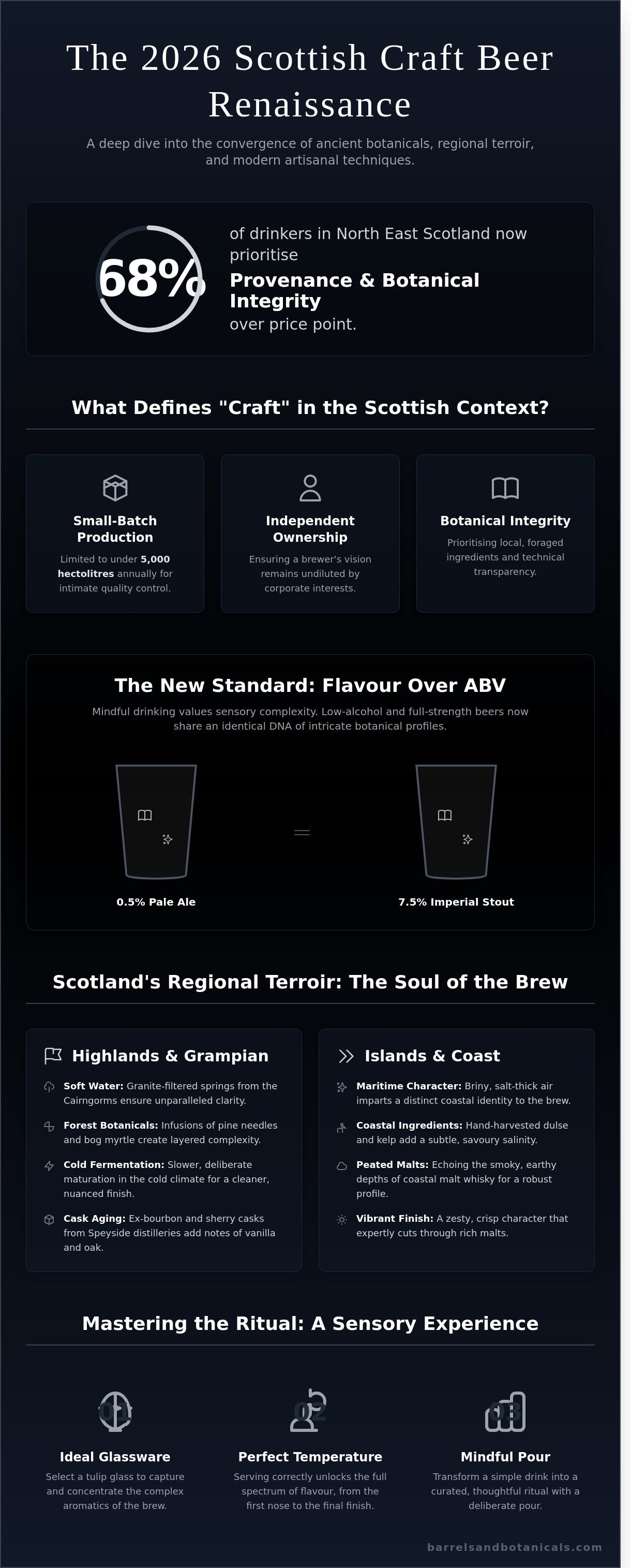
By early 2026, data from the Scottish Craft Brewers Association showed that 68% of drinkers in the North East prioritised "provenance and botanical integrity" over price. This year marks the era of nuanced complexity. It's about the layered notes of toasted oat, wild yeast, and hand-picked herbs. Independent, family-run bottle shops in Stonehaven and Aberdeen act as the essential gatekeepers for this movement. They curate the hidden gems that larger supermarkets overlook, offering a personal connection to the craft beer Scotland scene that industrial retail simply cannot replicate.
What Makes a Beer 'Craft' in the Scottish Context?
Craft implies a boundary. In the current market, this means small-batch production limits that rarely exceed 5,000 hectolitres annually. Quality control is intimate. Independent ownership ensures that a head brewer's vision isn't diluted by corporate boardrooms; it's about creative freedom and the courage to experiment. In 2026, Scottish craft beer is defined as an independently produced, small-batch beverage that prioritises local botanical integrity and technical transparency over industrial efficiency.
The Gain of Flavour: Beyond the Zero-Proof Narrative
We've moved past the language of lack. We no longer talk about what's missing; we talk about what's present. Low-alcohol and full-strength beers now share an identical DNA of complex botanicals. The mindful drinking movement in Aberdeenshire has transformed consumption into a deliberate ritual. It involves the correct glassware, a thoughtful garnish, and a moment of genuine pause. Whether it's a 0.5% pale ale or a robust imperial stout, the focus remains on the essence of the ingredient. The ABV is secondary to the palate. Vivid. Bold. Intentional. This is the new standard for craft beer Scotland enthusiasts who value clarity as much as complexity.
Regional Terroir: From Highland Springs to Coastal Hops
The foundation of craft beer Scotland lies in its water. Soft, granite-filtered springs from the Cairngorms provide a mineral-light base that ensures unparalleled clarity in every glass. It’s a sensory starting point. Pure. Crisp. Uncomplicated. High in the peaks, breweries draw inspiration from ancient Caledonian forests, infusing liquids with pine needles and bog myrtle. These botanical additions create a layered complexity that mirrors the landscape. This evolution is part of the wider sustainable craft beer boom that sees producers prioritising local provenance to reduce carbon footprints while enhancing flavour profiles.
Highland & Grampian: The Heart of the Brew
Aberdeenshire produces approximately 30% of the UK’s malting barley, providing a rich, cereal-forward backbone for local recipes. The region's biting cold isn't just a weather report; it's a brewing tool. Lower ambient temperatures during fermentation allow for a slower, more deliberate maturation process. This creates a cleaner, more nuanced finish. Many brewers now collaborate with nearby Speyside distilleries, using ex-bourbon and sherry casks for wood-ageing programmes. The result is a drink with notes of vanilla, toasted oak, and dried fruit. It’s a sophisticated ritual that honours the heritage of the North East.
Island Alchemy: Peat, Salt, and Seaweed
On the coast, the air is thick with brine. Hebridean and Northern Isle brewers embrace this maritime character, sometimes adding hand-harvested dulse or sugar kelp to the boil. These ingredients introduce a subtle, savoury salinity that cuts through rich malts. The drinking experience is zesty and vibrant, often featuring:
- Peated malts: Echoing the smoky, earthy depths of a coastal malt whisky.
- Maritime yeast: Experimental batches capture wild local flora for unique fermentation profiles.
- Zesty hops: Creating a bright contrast against the rugged, salt-sprayed cliffs.
Drinking these beers feels like a curated journey across the Atlantic edge. For those seeking this level of complexity and intentionality without the alcohol, exploring sophisticated alcohol-free botanicals offers a similarly refined sensory experience. In the Lowlands, innovation continues through the farm-to-glass movement. By 2025, several experimental sites aim to source 100% of their ingredients within a 20-mile radius, ensuring that the essence of the land is captured in every drop.
The Essential 2026 Roundup: Top Scottish Breweries to Explore
The landscape of craft beer Scotland offers today is a tapestry of grit and grace. By March 2026, the industry reached a record valuation of £340 million, driven largely by a 14% surge in demand for small-batch, limited releases. We define excellence through three rigorous pillars: flavour complexity, ethical grain sourcing, and technical innovation. Identifying a truly artisanal bottle requires a keen eye. Look for hand-numbered batches or specific harvest dates on the neck label. Authentic producers now frequently list the exact farm where their barley was malted, a level of transparency that 82% of premium buyers now expect from their local pour.
The Artisanal Leaders: A Comparison of Styles
| Brewery | Primary Style | Signature Note |
|---|---|---|
| Six°North | Belgian-Scot Hybrid | Wild Heather |
| Fierce Beer | Modern Stout | Roasted Cacao |
| Burnside | Botanical IPA | Gorse Flower |
The 'North East Nectar' presents a nose of damp pine and wildflower. On the palate, it delivers a crisp, biscuity finish that lingers. 'Granite Dark' offers a nose of heavy espresso. Its palate is velvet, smoke, and indulgence. 'Coastal Gorse' smells of toasted coconut. It tastes zesty and sharp. These are the hidden gems. You won't find these bottles in a supermarket aisle; they live in independent bottle shops and harbour-side taprooms where the ritual of the drink is respected.
The Evolution of the IPA and Stout in Scotland
The Scottish palate has matured beyond the aggressive, bitter hop-bombs of the last decade. Today's botanical IPAs are nuanced. They're fruit-forward. Brewers now use cold-pressed essences and locally foraged herbs to build layers of vibrant flavour. While the 'Pastry Stout' has gained a following for its dessert-like decadence, the traditional Scottish Porter remains the backbone of the north for its reliability. The real magic happens in the wood. By July 2026, over 65% of independent brewers in Aberdeenshire began utilising ex-whisky casks from Speyside and the Highlands. This barrel-ageing process imparts a vanillin sweetness and a ghostly peaty whisper. It's a uniquely Scottish strength. Quality takes time. The wait is the reward.
Mastering the Ritual: Tasting and Pairing Your Favourites
Pouring a glass of craft beer Scotland produces is an act of intentionality. Forget the uniform pint glass found in every local pub. Reach for a tulip glass instead. Its inward-curving rim captures the volatile aromatics that a standard straight-sided glass loses, allowing the nose to engage before the first sip. Temperature is equally critical. While a crisp lager thrives at 4°C, a complex Aberdeenshire ale reveals its soul at 12°C. Serving it too cold numbs the tongue and hides the intricate botanical notes the brewer worked to preserve. Look for the lacing; those persistent foam rings on the glass signify quality ingredients and a pristine pour. These visual markers are the first steps in a deeper sensory journey.
The Five-Step Tasting Process
- Observe: Hold the glass to the light to evaluate the clarity and the depth of the hue.
- Swirl: Agitate the liquid gently to release the bouquet trapped within the foam.
- Inhale: Take short, sharp sniffs to identify notes of pine, citrus, or toasted biscuit.
- Sip: Let the beer coat your entire palate to register sweetness, bitterness, and acidity.
- Evaluate: Focus on the finish.
The lingering finish of a premium craft beer Scotland offers is as definitive and essential to the experience as a 12-year-old single malt whisky. To maintain clarity between different styles, cleanse your palate with a plain Aberdeenshire oatcake or a sip of room-temperature water. This practice ensures that the delicate esters of a Saison don't clash with the heavy char of a Porter.
Craft Beer and Cigars: The Ultimate Scottish Ritual
A mindful evening in Turriff deserves a pairing that challenges the senses. Smoky stouts find their natural equal in the earthy profile of a premium cigar. The roasted malts mirror the charred notes of the tobacco, creating a unified sensory experience that lingers. Match the intensity with precision. A light Connecticut wrapper complements a vibrant blonde ale or a citrus-forward IPA, while a dark, oily Maduro wrapper demands the weight and chocolate undertones of a 9% Imperial Stout. This ritual transforms a simple beverage into a curated moment of stillness. It's a celebration of craftsmanship that rewards the patient drinker who values quality over quantity.
Discovering Artisanal Excellence at Barrels & Botanicals
Our Turriff boutique serves as a dedicated gallery for the finest craft beer Scotland produces. Since we established our physical presence, we've focused on liquid artistry that tells a story of the soil, the water, and the season. As a family-run business, we don't just stock shelves; we curate experiences. You'll find between 15 and 25 rotating small-batch breweries represented at any given time, each selected for their refusal to compromise on quality. We champion the local talent of Aberdeenshire alongside the boldest innovators in the Scottish brewing scene. Our collection reflects a wider passion for refined, intentional living. Beyond the hops, we house over 200 distinct whiskies, hand-selected botanical gins, and a climate-controlled humidor for premium cigars. It's about the complete sensory ritual. Bold flavours. Expertly sourced. Zero compromise.
A Personal Invitation to Our Turriff Boutique
The air in our Turriff shop carries the faint, sophisticated scent of cedar and aged grain. Browsing our shelves is a tactile journey where we encourage you to slow down. We guide you through the profiles of a crisp, citrus-forward IPA or a heavy, peat-smoked porter. It's a dialogue, not just a transaction. We help you find the perfect bottle for a milestone celebration or a quiet Tuesday evening ritual. For those residing further afield, our national delivery service ensures these artisanal treasures reach any UK doorstep within 2 to 3 working days. We bring the boutique experience to your home with the same meticulous care we provide in person.
Join the Barrels & Botanicals Ltd Community
Stay connected to the pulse of the industry through our community updates. We provide our regulars with early access to rare releases and exclusive brewery collaborations that often sell out within 48 hours of hitting the shelves. For the serious connoisseur, our private bottle brokerage offers a discreet, bespoke path to acquiring world-class spirits and vintage beers that are rarely seen on the open market. We act as your eyes and ears in the craft world, ensuring you never miss a significant release. Explore our curated craft beer collection today and elevate your next pour with a selection that truly matters. Every bottle is a legacy of Scottish craft.
Savour the Spirit of the Scottish Renaissance
The landscape of craft beer Scotland has reached a pinnacle of sensory excellence in 2026. You've explored how regional terroir defines the palate; from the mineral-rich Highland springs to the salt-kissed hops of the coast, the depth of flavour is unmatched. This era isn't just about brewing. It's about the ritual of the pour and the precision of the pairing. It's a celebration of artisanal quality that rewards the patient, mindful drinker. Every glass tells a story of landscape and legacy. Vibrant profiles. Nuanced finishes. Pure excellence.
Since 2019, our family-run team at Barrels & Botanicals has championed this movement. We don't settle for the ordinary. We specialise in old and rare collectibles alongside an expertly curated small-batch selection that captures the essence of the 120+ independent breweries currently thriving across the UK. Our collection is a testament to the master blender's art. We invite you to slow down and appreciate the meticulous sourcing behind every bottle. Discover the finest craft beer Scotland has to offer at Barrels & Botanicals. Step into a world where every sip is an intentional act of discovery. Your next favourite vintage awaits.
Frequently Asked Questions
What is the best craft beer in Scotland for beginners?
A Session IPA or a light Blonde Ale is the ideal entry point for those exploring craft beer Scotland for the first time. These styles offer a gentle introduction to vibrant profiles without overwhelming the palate. Look for BrewDog’s Dead Pony Club or Fierce Beer’s Cranachan Killer. These brews provide a balanced finish and accessible citrus notes. They make the first sip a true celebration.
How long does bottled craft beer stay fresh?
Most bottled craft beers remain at peak freshness for 3 to 6 months after the bottling date. Hop-forward styles like IPAs lose their aromatic essence quickly; you should drink these within 90 days. Darker stouts or barrel-aged releases can evolve beautifully for 2 to 5 years. Always check the "packaged on" date for the best ritual experience. Freshness is the key to clarity.
Is there a difference between real ale and craft beer?
Real ale is a live product served from the cask without added CO2, while craft beer focuses on innovative techniques and bold botanical profiles. Craft beer is often carbonated and served from kegs or cans to maintain a crisp, vibrant mouthfeel. While 85% of real ales follow traditional CAMRA guidelines, craft brewers embrace experimental ingredients. It's a modern evolution of a classic craft.
What are the most popular Scottish craft beer styles in 2026?
Low-alcohol botanic infusions and cold-conditioned Lagers dominate the 2026 Scottish market. Data from the 2025 Brewing Report shows a 22% increase in demand for alcohol-free alternatives that don't sacrifice the complex nose of a traditional brew. Modern drinkers prioritise nuanced flavours. Expect to see more heather-infused pilsners and coastal-inspired sours appearing in local taprooms throughout this year. Quality over volume is the current trend.
Can I buy rare Scottish craft beers online for UK delivery?
Yes, specialist retailers like Beer Merchants or brewery-direct shops offer next-day UK delivery for roughly £6.99. You can access limited editions from Aberdeenshire’s finest producers with just a few clicks. It's a seamless way to bring the essence of the Highlands to your doorstep. Many sites provide free shipping on orders over £50. This ensures your home bar remains stocked with premium, artisanal choices.
How should I store my craft beer to maintain its flavour?
Store your bottles upright in a cool, dark space kept at a constant 10 to 12 degrees Celsius. Heat and light are the enemies of a delicate palate. UV rays can skunk a beer in under 10 minutes. By keeping your collection refrigerated, you preserve the vibrant hops. This ensures every pour is a celebration of quality. Respect the liquid; treat the storage as a vital ritual.
Are there any gluten-free craft beers brewed in Scotland?
Scotland boasts over 15 dedicated breweries producing award-winning gluten-free options. Bellfield Brewery in Edinburgh and Windswept Brewing in Lossiemouth lead the way with certified gluten-free ranges. These beers use enzymes to break down gluten proteins during fermentation. You get the full, grainy depth of craft beer Scotland with none of the dietary compromise. It's an inclusive approach to high-end brewing that values every drinker's experience.
What makes Aberdeenshire a hub for craft brewing?
Aberdeenshire’s success stems from its access to 25% of the UK’s malting barley and pure water from the Grampian Mountains. This fertile landscape has birthed over 20 independent breweries. The region’s brewing heritage dates back to 1740. It combines traditional grit with a modern, adventurous spirit. Every pour from this region reflects a commitment to artisanal quality and local essence. It's where nature meets meticulous craft.