

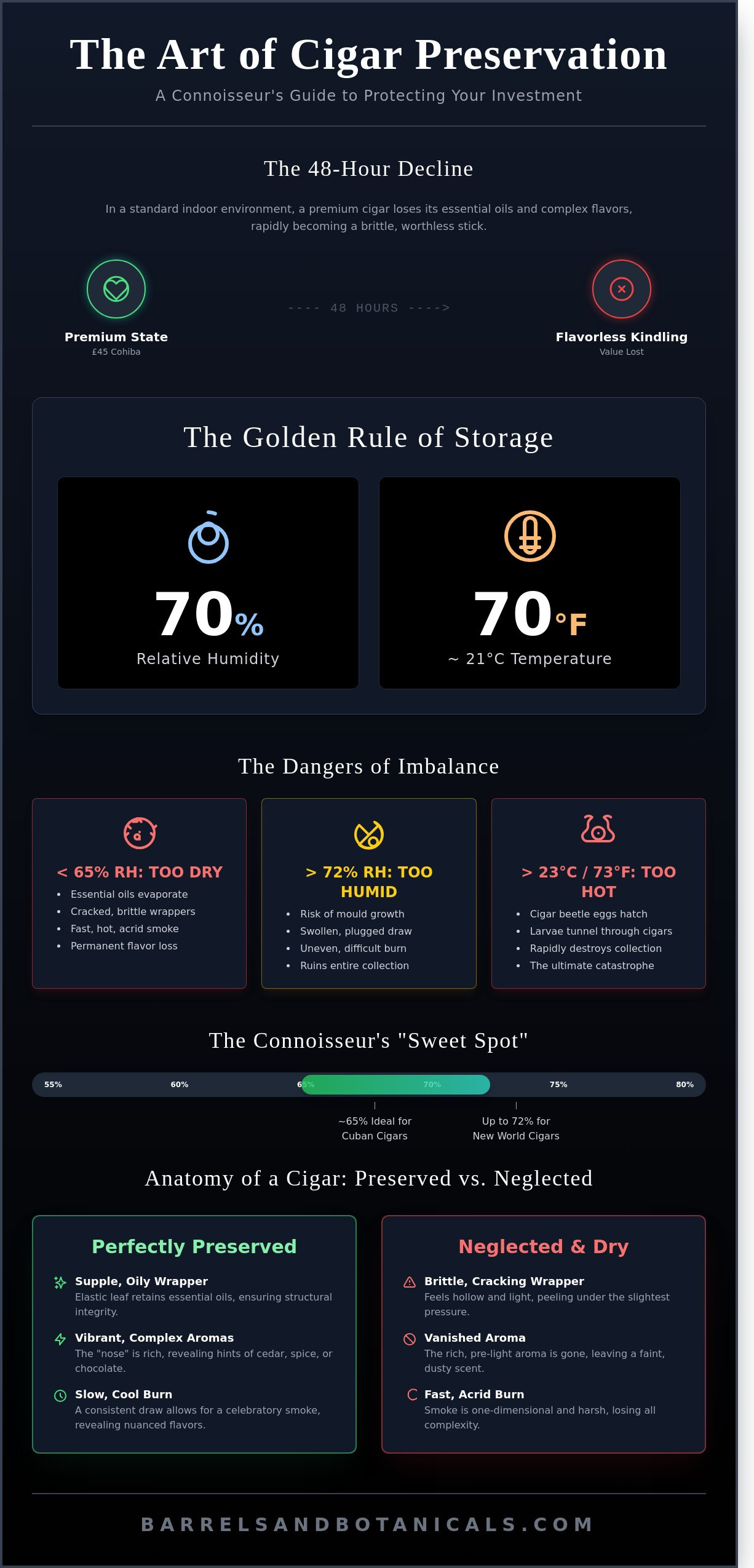
A premium cigar is a living, breathing masterpiece. Neglect it for just 48 hours in a standard British living room, and you have effectively turned a £45 Cohiba into a brittle, flavourless stick of kindling. It is a heartbreaking loss of artisanal craft. You likely understand the quiet anxiety of reaching for a special smoke, only to fear the oils have evaporated and the soul of the tobacco has vanished. It's time to move beyond the confusion of conflicting humidity levels and inconsistent advice.
This guide teaches you exactly how to store cigars to ensure every draw remains a vibrant symphony of perfectly preserved aromas and nuanced flavours. We will master the vital 70/70 rule, determine if your collection requires an immediate humidor, and reveal the precise, patient ritual needed to rescue a dry cigar from the brink. Prepare to curate a sanctuary where quality is the only option and every moment of consumption is treated with the respect and patience it deserves.
Key Takeaways
- Treat your collection as a living organic product by learning to preserve the essential oils and nuanced aromas that define a premium smoke.
- Master the delicate 70/70 balance of humidity and temperature to protect your investment from the risks of mould and dryness.
- Explore the modern landscape of how to store cigars, contrasting the traditional beauty of Spanish cedar with the airtight precision of contemporary alternatives.
- Perfect the ritual of humidor maintenance, from initial seasoning to regular air circulation, to keep your cigars in peak condition.
- Transition from mere preservation to a curated experience where perfectly kept tobacco becomes the foundation of a mindful evening ritual rich in flavour.
The Ritual of Preservation: Why Learning How to Store Cigars Matters
A premium cigar is a living, breathing organic entity. It's an evolving masterpiece of agriculture and craft. From the moment a master torcedor rolls the final leaf, the tobacco begins a journey of maturation that can last for decades. Understanding how to store cigars is an act of stewardship. It's the intentional control of a micro-climate to protect the volatile oils and delicate aromas that define a blend's character. Without this care, the artistry of the blender evaporates into the air.
Storage is the bridge between the factory and the flame. When you curate a collection, you're managing a delicate balance of moisture and temperature. This environment allows for the "marrying" of flavours. When different sticks share a sanctuary, their distinct botanical profiles subtly interact, creating a more cohesive and rounded sensory experience. To maintain this harmony, many enthusiasts research what is a humidor to find a vessel that offers both aesthetic beauty and technical precision. It is the final, essential step in an artisanal journey that began years ago in the soil.
The Anatomy of a Dry Cigar
Neglect leaves physical and sensory scars. A dehydrated cigar feels hollow, light, and dangerously brittle. The wrapper, which should be oily and supple, begins to crack or peel under the slightest pressure. You'll notice the "nose," that rich, pre-light aroma, has vanished. When lit, a dry stick burns fast and hot. The smoke becomes acrid and one-dimensional, losing the complex finish intended by the maker. Standard wooden gift boxes are insufficient for this task. They lack the airtight seals and humidification systems needed to combat the UK’s indoor environments, where central heating can drop humidity levels to below 30% during winter months.
The Sensory Impact of Proper Humidity
Precision moisture, ideally maintained between 65% and 72% relative humidity, keeps the botanical notes vibrant. A well-hydrated leaf retains its elasticity and essential oils. This ensures a slow, cool, celebratory smoke that allows your palate to detect nuanced hints of cedar, spice, or dark chocolate. The draw remains consistent. The ash stays firm. By mastering how to store cigars, you aren't just preserving tobacco; you're honouring the time and patience required to create it. It's an investment in quality that ensures every draw is as rewarding as the master blender intended.
- Living Product: Tobacco continues to ferment and age after production.
- Oil Preservation: Humidity keeps essential oils from evaporating.
- Flavour Marrying: Shared storage allows profiles to harmonise over time.
- Structural Integrity: Proper moisture prevents wrappers from cracking or unraveling.
The Golden Rule: Mastering Temperature and Relative Humidity
The soul of a premium cigar lies in its moisture content. To preserve this essence, connoisseurs follow the 70/70 rule. This standard calls for 70% relative humidity (RH) and a temperature of 70°F, which is approximately 21°C. It's a delicate equilibrium that requires constant attention. Balance is everything. Excess dampness invites white or blue mould to bloom on the wrapper, potentially ruining the entire batch. Conversely, a dry environment causes essential oils to evaporate. Once those oils vanish, the vibrant character and nuanced flavours of the tobacco are lost forever.
Temperature control serves as a vital shield against the dreaded cigar beetle. These pests remain dormant in the leaf until the mercury hits 23°C. Once they hatch, they can tunnel through a £500 collection in a single weekend. While the 70/70 rule is a baseline, consistency matters more than hitting a perfect number every second. Rapid fluctuations are the true enemy. They cause the tobacco to swell and shrink, which often splits the delicate outer leaf or creates a tight, unsmokeable draw. Learning how to store cigars is as much about stability as it is about specific metrics.
Understanding Relative Humidity (RH)
RH is the amount of water vapour present in the air compared to the maximum amount the air can hold at that specific temperature. For most enthusiasts, the sweet spot for storage sits between 65% and 72%. Cuban cigars often perform best at the lower end of this scale, around 65%, while New World sticks from Nicaragua or the Dominican Republic can handle slightly more moisture. Always use a calibrated digital hygrometer for peace of mind. Analogue versions look classic, but they often lack the precision needed to protect a serious investment.
The Influence of the British Climate on Storage
In the UK, indoor air changes dramatically with the seasons. Winter central heating creates a desert-dry atmosphere where indoor RH can plummet below 30% in hours. British summers frequently bring humidity spikes that can lead to over-saturation if your humidor isn't well-sealed. To maintain a stable environment, follow these steps:
- Avoid heat sources: Never place your humidor near a radiator or on a mantelpiece.
- Seek the shade: Direct sunlight through a window can raise internal temperatures by 5°C in minutes.
- Choose a stable room: A north-facing study or a cool cellar shelf provides the most consistent thermal mass.
As you refine this preservation ritual, you might find that a nuanced alcohol-free blend provides the perfect clean palate to appreciate the complex tobacco notes you've worked so hard to protect. Understanding how to store cigars ensures that when the moment for a smoke finally arrives, the experience is exactly as the master blender intended. Bold. Balanced. Pristine.
Selecting Your Sanctuary: Humidors, Tupperdors, and Temporary Solutions
Choosing how to store cigars is a decision that balances heritage with modern precision. The vessel is more than a container; it's a micro-climate designed to protect a delicate investment. In 2026, the landscape offers a choice between the romanticism of the wooden box and the clinical reliability of airtight polymers. Whether you seek the tactile pleasure of a heavy lid or the "set and forget" simplicity of a sealed container, the goal remains a stable environment. Central to this are humidification elements. Modern Boveda packs, using patented two-way salt solutions, have largely replaced older foam or crystal systems. They provide a consistency that preserves the nuanced oils and vibrant essence of the tobacco leaves.
The Classic Spanish Cedar Humidor
The gold standard remains Spanish Cedar (Cedrela odorata). It is not actually cedar but a relative of mahogany. It possesses a unique ability to breathe, absorbing excess moisture and releasing it when the air grows thin. The aroma is woody and subtle. It serves as a natural deterrent to the tobacco beetle, a pest that can ruin a collection in days. A well-crafted humidor is a statement piece for any home bar. It is a ritualistic object that demands a proper seasoning process before it can safely cradle your collection. This typically involves a 14-day programme using high-humidity packs to saturate the wood grain, ensuring the box doesn't sap moisture from your sticks.
The Rise of the 'Tupperdor' and Coolerdor
For those managing larger collections or seeking absolute airtight efficiency, the 'Tupperdor' is the modern solution. Using BPA-free, gasket-sealed plastic containers ensures zero moisture loss. It is a functional, transparent choice. To regain the essential sensory profile of a traditional box, many aficionados place Spanish cedar spills or thin dividers inside. This creates a hybrid environment: the stability of plastic with the aromatic finish of wood. It is an exceptionally cost-effective route. A high-quality container that holds 25 sticks often costs less than £20, allowing you to spend more of your budget on the cigars themselves. For massive collections, converted insulated coolers offer the same airtight benefits on a grander scale.
With the savings from a cost-effective storage solution, you can focus on building your collection from a diverse online retailer like Gotham Cigars.
Emergency Storage Hacks
If you find yourself with a premium stick and no permanent home for it, speed is essential. A cigar can survive in a shop-sealed bag for about 48 to 72 hours before the humidity levels begin to drop. For a makeshift solution, use a Ziploc bag and a small, damp, but not soaking, sponge. Ensure the sponge never touches the tobacco directly to avoid mould growth. This will buy you roughly seven days of time while you source a proper sanctuary. When you are learning how to store cigars, remember that stability is your primary objective. Avoid windowsills or areas near radiators. Consistency is the hallmark of the true connoisseur.
- Spanish Cedar: Best for aroma and long-term ageing.
- Airtight Plastic: Best for maintenance-free stability.
- Boveda Packs: The preferred choice for 69% to 72% relative humidity.
- Seasoning: A mandatory 14-day step for all new wooden humidors.
The Connoisseur’s Routine: Maintenance, Seasoning, and Organisation
Mastering how to store cigars requires more than a beautiful cedar box; it demands a cadence of care. Think of your humidor as a living ecosystem that breathes. You should "burp" the lid once every 14 days to introduce fresh oxygen. Stale air is the enemy of nuance, often inviting mould or a musty finish. Check your digital hygrometer every seven days. If the reading dips below 65% RH, it's time to recharge your humidification source. This isn't a chore. It's a ritual of preservation. Rotate your sticks every 30 days. Moving the bottom layer to the top ensures every cigar enjoys equal exposure to the humidified air, preventing "dry spots" in a crowded collection.
How to Season Your New Humidor
Spanish cedar is thirsty. If you don't season a new humidor, the wood will steal moisture directly from your cigars, leaving them brittle and tasteless. Follow this deliberate process to prime your sanctuary:
- Step 1: Lightly wipe the interior cedar walls with a new sponge dampened with distilled water. Alternatively, place 84% RH seasoning packs inside for a slow, deep saturation over 14 days.
- Step 2: Close the lid and wait for the internal humidity to stabilise. This usually takes 72 to 120 hours. Resist the urge to peek.
- Step 3: Calibrate your hygrometer using a salt test. Place a teaspoon of salt with a few drops of water in a bottle cap inside a sealed bag. After 24 hours, the gauge should read exactly 75%.
The Cellophane Debate: To Strip or Not?
The thin sleeve surrounding your cigar is actually a natural, breathable polymer made from cellulose, not plastic. Keeping it on provides a physical buffer against "foot" damage and prevents flavour bleeding between different blends. However, removing it allows for a faster "marriage" of oils and better air circulation. If you're a casual collector, keep the cellophane on 90% of your stock to protect the delicate wrappers. Only strip the cigars you intend to age for several years, allowing their essence to evolve without a barrier.
Organising for the Palate
Sensory integrity is paramount when considering how to store cigars for the long term. You must separate mild, creamy Connecticuts from bold, spicy Maduros. Darker leaves carry potent oils that can migrate, muddying the profile of lighter sticks. Use cedar dividers to create distinct zones. Label every cigar with its purchase date using a small tag. A cigar aged for 730 days offers a vastly different profile than a fresh one. This meticulous care ensures that when you explore a whisky and cigar pairing, the tobacco’s intended notes remain pure and vibrant.
Elevate your next tasting experience by discovering our curated selection of premium alcohol-free spirits designed for the mindful epicurean.
Beyond Storage: Elevating the Cigar Experience with Barrels & Botanicals
Mastering how to store cigars is only half the battle; the true art lies in the ritual of the smoke. Preservation isn't an end in itself. It's the essential preparation for a sensory performance. A perfectly kept cigar serves as the foundation for an evening of mindful indulgence. It's the difference between a harsh, uneven burn and a smooth, evolving journey of flavour. Your humidor shouldn't just be a box. It's a curated cellar, much like a collection of fine whiskies, where each stick waits for the precise moment it's called to the stage.
Your collection represents a timeline of tastes and memories. Treat it with the same reverence a master blender shows their most prized barrels. When the environment is stable, the tobacco matures, mellows, and gains a complexity that rewards the patient connoisseur. This is where storage meets soul. The ritual begins the moment you select your stick, feeling the slight give of a perfectly humidified wrapper between your fingers.
Pairing Your Perfectly Kept Cigar with Single Malt
Humidity dictates the dance between leaf and liquid. When you understand how to store cigars at a consistent 68% to 70% level, you ensure the tobacco retains the essential oils needed to stand up to a bold Scotch. A dry cigar burns too hot, incinerating the delicate notes that should complement your drink. A well-preserved Cuban stick, with its earthy and floral profile, requires a partner that won't overwhelm it. We suggest matching the elegant nose of a Speyside malt with a lighter-bodied smoke to allow the honeyed, fruity notes of the spirit to shine through.
At Barrels & Botanicals, we provide the artisanal spirits and complex liquids that complete this experience. Whether you're reaching for a traditional single malt or one of our sophisticated, botanical-led alternatives, the goal is a harmonious finish. Consider these pairing principles:
- Islay Malts: Pair with full-bodied, spicy Nicaraguan cigars to match the peat and smoke.
- Highland Malts: These versatile spirits suit medium-bodied sticks with nutty or cocoa undertones.
- Botanical Blends: Our alcohol-free distillations offer a clean, vibrant palate that highlights the cedar notes in aged tobacco.
Curating Your Collection in 2026
In 2026, the modern connoisseur moves away from bulk hoarding. The trend focuses on intentionality. Curate a mix of everyday smokes and rare, vintage sticks reserved for specific rituals. We recommend buying in small batches of 10 to 15. This allows for tighter quality control within your humidor and ensures you can maintain the perfect environment without the air-flow issues often found in overstuffed boxes. This approach values the essence of the tobacco over the volume of the hoard.
This mindful procurement ensures every puff is a deliberate choice rather than a habit. Your collection should be a vibrant, evolving reflection of your palate. Start building your cellar today with selections that honour the tradition of the craft. Explore our curated selection and buy cigars online UK to elevate your next evening ritual.
Savour the Ritual of Perfect Preservation
Mastering the delicate balance of 18°C to 21°C and 65% to 70% relative humidity transforms simple storage into an artisanal ritual. When you understand how to store cigars with this level of precision, you protect the nuanced oils and vibrant essences of every hand-rolled leaf. It's a commitment to quality that ensures each draw remains exactly as the master blender intended. From the initial seasoning of a cedar humidor to the rhythmic organisation of your collection, these small acts of patience yield a superior sensory experience.
At Barrels & Botanicals, we bring family-run expertise from our base in Turriff directly to your glass and humidor. Our specialists curate a refined selection of New World and Cuban cigars alongside old and rare single malts that define the peak of Scottish distilling. We believe in the gain of complex flavours and the elegance of a well-timed pour. Discover our hand-picked range of premium cigars and artisanal spirits to elevate your next evening of mindful indulgence. Your collection deserves nothing less than perfection.
Frequently Asked Questions
Can I store cigars in the fridge?
No, you shouldn't store cigars in the fridge because the environment is far too dry and cold for delicate tobacco leaves. Refrigerators are designed to remove moisture, which will strip a cigar of its essential oils within 24 hours. The internal temperature usually sits at 4°C, far below the ideal 18°C to 21°C. Additionally, porous wrappers easily absorb food odours like onions or cheese, ruining the nuanced botanical profile of your smoke.
How long do cigars last without a humidor?
A premium cigar will typically last between 48 and 72 hours outside of a humidor before it begins to lose its essential moisture. In the UK's variable climate, dry indoor heating can accelerate this process. If you're wondering how to store cigars without professional equipment, use a sealed freezer bag or a Tupperware container with a humidification pack. This temporary measure preserves the craft and flavour for up to 30 days.
What is the best humidity for cigars in the UK?
The ideal humidity for cigars in the UK is generally between 65% and 70% relative humidity (RH). Because the British climate is often damp, many connoisseurs prefer a slightly lower setting of 62% to 65% to prevent the tobacco from becoming too soft. Maintaining a steady temperature of 18°C is equally vital. Fluctuations of more than 5% RH can cause the wrapper to expand and crack, disrupting the ritual of a perfect burn.
Can I revive a dry cigar that has become brittle?
You can often revive a dry cigar if the wrapper hasn't physically cracked or become brittle to the touch. This process requires patience and must be done slowly over a period of 4 to 6 weeks. Start by placing the cigars in a humidor at 60% RH, gradually increasing the moisture by 2% every fortnight. Rushing this recovery with high humidity will cause the filler to swell too fast, splitting the delicate outer leaf.
Do I need to use distilled water in my humidor?
You must use distilled water in your humidor to prevent the growth of mould and the buildup of mineral deposits. Tap water contains chlorine and minerals that can taint the aroma of your collection and clog the pores of your humidification element. Using 100% pure distilled water ensures a clean environment. It protects your investment and maintains the integrity of the tobacco's natural essence without introducing unwanted chemicals or spores.
What happens if my humidor gets too humid?
If your humidor exceeds 72% humidity, you risk the development of white mould or a devastating tobacco beetle infestation. Over-humidified cigars become difficult to light and often burn unevenly. The tobacco swells, making the draw feel tight and plugged. If your hygrometer reads 75% or higher for more than 48 hours, leave the lid open for a few hours to allow the excess moisture to dissipate into the room.
Is it okay to store different brands of cigars together?
It is perfectly acceptable to store different brands together, though long-term cohabitation can lead to flavour marriage. Over a period of 6 to 12 months, the distinct aromas of a spicy Nicaraguan leaf may bleed into a milder Dominican blend. If you want to preserve the specific profile of a rare vintage, use cedar dividers within your humidor. This keeps the individual essences separate while still benefiting from a shared, controlled environment.
How often should I check my humidor's humidity levels?
Check your humidor's humidity levels at least once every 7 to 10 days to ensure a stable environment. Digital hygrometers are preferred for their accuracy, often within 2% of the actual reading. A quick weekly glance allows you to spot fluctuations caused by seasonal changes in British weather. This consistent habit is a vital part of the cigar ritual, ensuring every stick is ready for a mindful, celebratory moment of relaxation.
For those who enjoy a flavorful ritual but prefer to avoid the meticulous maintenance of a humidor, modern vaping offers a straightforward alternative. These devices require no special storage, providing a consistent experience without the complexities of humidity control. If you're interested in exploring this option, you can learn more about Vape Center, a UK-based specialist.